



AI in procurement should help companies buy better—with more context, control, and speed—and not just reduce tasks or personnel. When applied correctly, it improves the quality of the request, speeds up the reading of quotations, highlights risks in contracts, and gives buyers and managers time to focus on areas where they are irreplaceable: decision-making, negotiation, supplier relations, and exception management.
This is the discussion gaining traction in procurement areas. Technology can perform relevant parts of the operational work, but the management question is different: will the gain translate into a linear reduction in capacity or into a more strategic purchasing area?
The debate was directly exposed by the *CPO Crunch* newsletter from Procurement Leaders: while some leaders argue that automation frees up the team for higher-value activities, others report pressure to drastically reduce staff. The point is not to choose between efficiency or people. It's about designing an operation where AI increases the quality of decision-making and preserves governance. Read the analysis from Procurement Leaders..
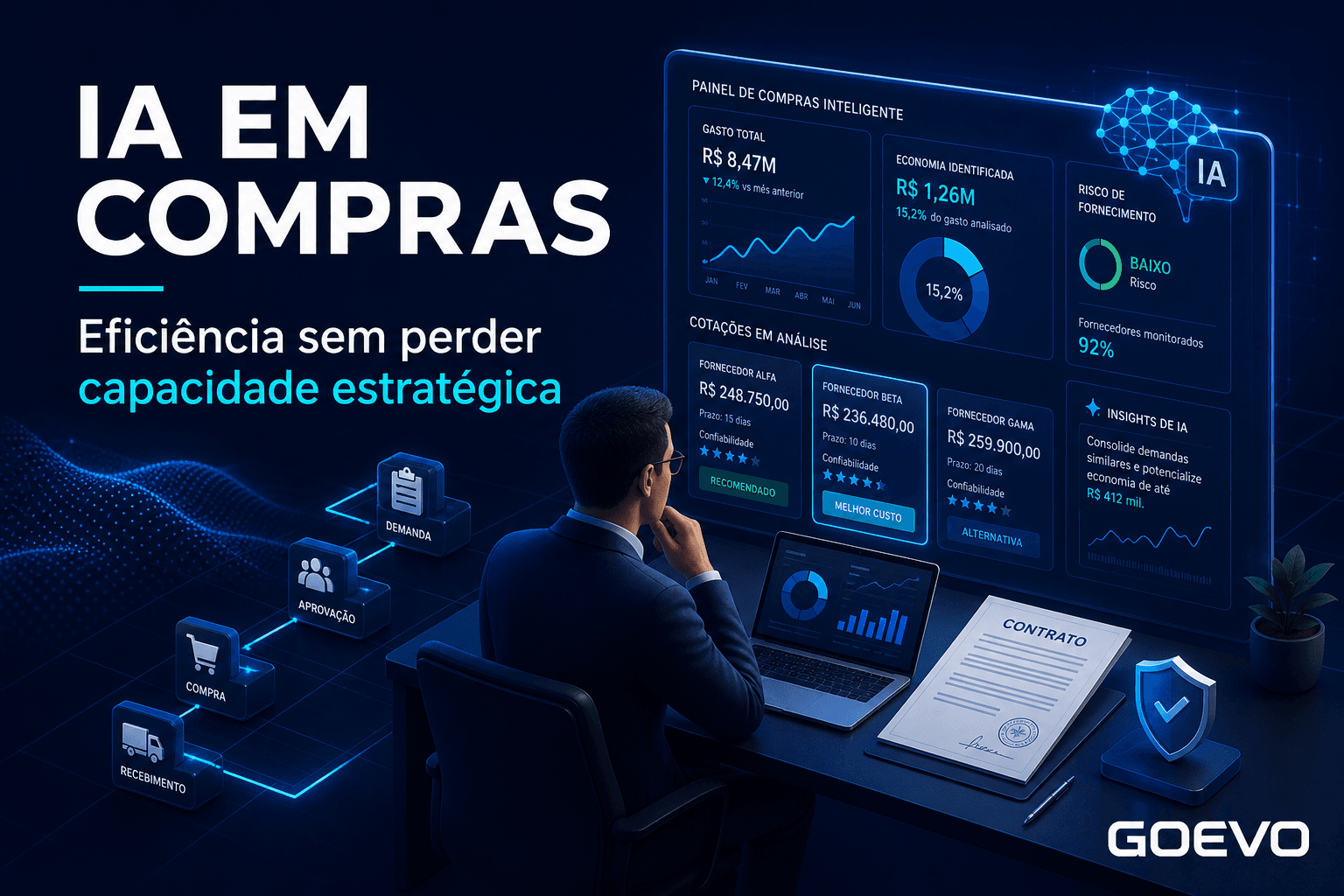
AI in Procurement: Professional at the heart of the decision-making process, connected to the requisition, quotation, and contract.
AI applied to the purchasing process: more context for requesting, comparing, and deciding.
\n
The AI Paradox in Procurement
Purchasing has always been pressured to do more with less: reduce costs, ensure supply, comply with policy, compare suppliers, address emergencies, and maintain traceability. AI seems like an immediate answer because it can read, organize, compare, and suggest in seconds.
But speed without criteria only accelerates bad decisions. A poorly specified request remains poorly specified; a quote with incomparable scope remains incomparable; and a sensitive contractual clause does not cease to require validation just because it was summarized by an algorithm.
Therefore, the mature adoption of AI in Procurement follows three principles:
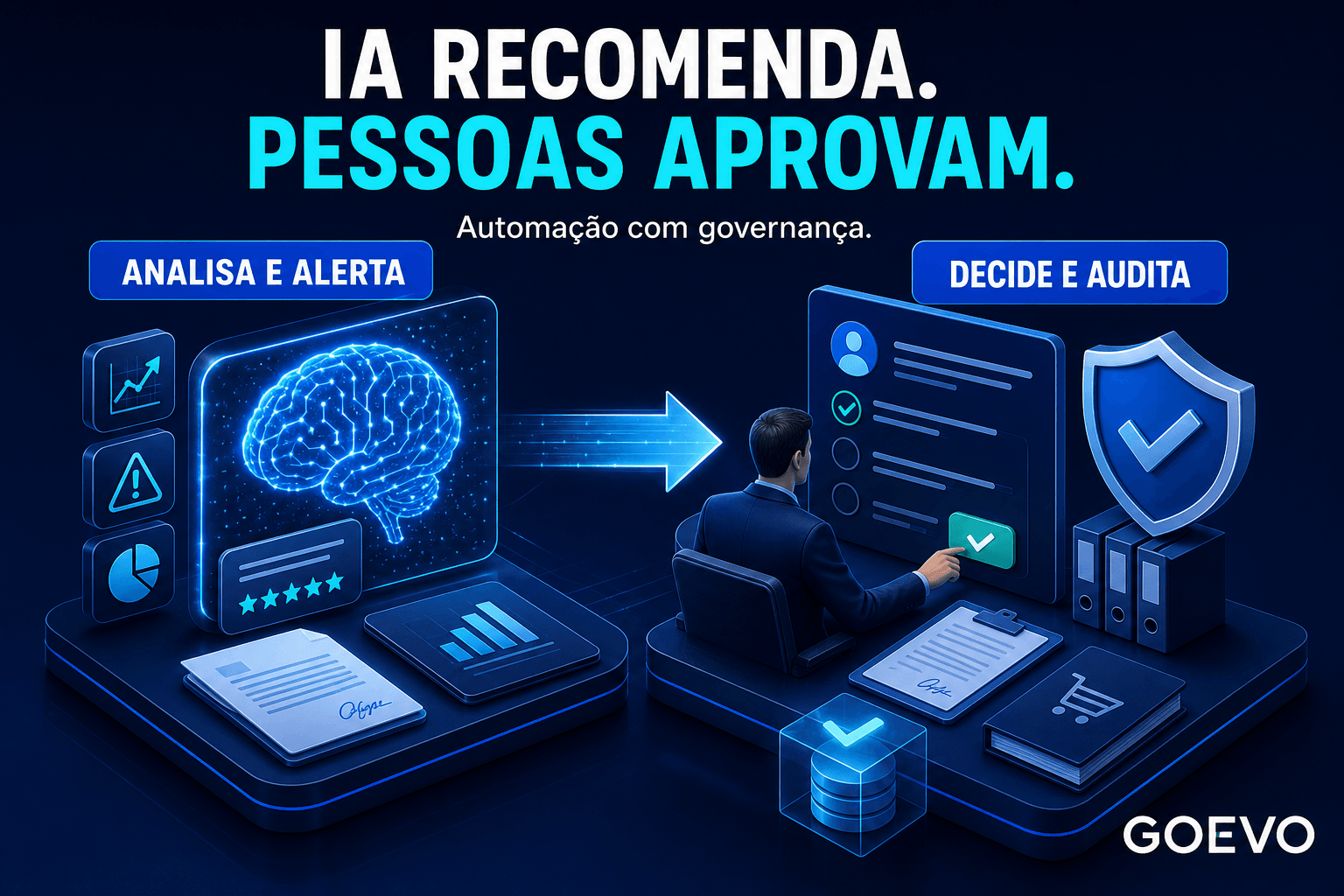
- AI prepares and explains; people decide and approve.
- The recommendation needs to be linked to the data and the rules of the process.
- Success is measured by quality, control, and business results — not just by hours saved.
This concern is consistent with the broader work environment. The World Economic Forum indicates that AI and information processing are expected to transform businesses by 2030, but also highlights that human skills such as analytical thinking, leadership, resilience, and collaboration remain critical. The most common response from companies is to retrain teams to work better with the technology. See the *Future of Jobs Report 2025*.
Where AI generates practical value in the purchasing process.
At GOEVO, we see AI as a practical layer on top of the procurement process. It shouldn't replace ERP, the approval workflow, or the buyer's responsibility. It should help each participant enter the process with better information and exit with a more consistent decision.
1. More complete and useful requests from the source.
A large portion of rework in purchasing begins before the quotation. The requester describes something in a generic way, failing to specify the cost center, deadline, specifications, delivery location, or justification. The buyer receives the incomplete request and needs to initiate an exchange of emails or messages to discover the basics.
An AI system well integrated into the request form can act as an assistant to the requester. Instead of simply accepting a free text field, it can:
- identify missing fields for the requested category;
- to suggest a more objective description of the item or service;
- Please specify the quantity, unit of measurement, deadline, and location when this information is required.;
- To alert you to the possibility of a duplicate purchase already in progress;
- To guide the applicant regarding the documents, attachments, or approvals required by the policy;
- To indicate that the need may be covered by a contract, catalog, or approved supplier.
Practical example: Someone requests "maintenance service." The AI can signal that the request still needs to specify the equipment, unit, scope, service window, evidence of need, and cost center. The goal is not to block the user; it's to prevent the quote from starting without a basis for comparison.
The expected result is a better entry point for the Purchasing area: less back and forth, more speed, and a clear trail of what was requested and why.
Understand how to structure an efficient purchasing process. And why a good specification needs to come before the quotation stage.
2. Analyze price quotes with context, not just the lowest price.
Choosing the lowest bid is not the same as choosing the best purchase. A quote may have a lower price but, at the same time, contain an inadequate delivery time, an out-of-specification item, unfavorable payment terms, shipping not included, or supplier risk.
Here, AI can help structure the comparison. Based on proposals and process data, it can summarize differences, point out missing fields, and highlight areas that deserve the buyer's attention.
- Unit price, quantity, taxes, shipping, and total value;
- Delivery deadline and validity of the proposal;
- Discrepancies between quoted items and requested items;
- Payment terms, warranty and customer service;
- Suppliers without valid documentation or with pending approval issues;
- Purchase history, price variation, and adherence to the existing contract.
Practical example: Three suppliers respond to a materials quote. Proposal A has the lowest total value but a 45-day delivery time. Proposal B costs 4% more, delivers in 10 days, and is already approved. Proposal C has a competitive price but excludes freight and does not provide a warranty. AI can organize this map and explain the differences; the decision remains with the buyer and the company's defined limits.
This approach reduces the mechanical work of reading and increases the quality of the negotiation conversation. Instead of spending time consolidating spreadsheets, the team discusses total cost, risk, timeline, and business alignment.
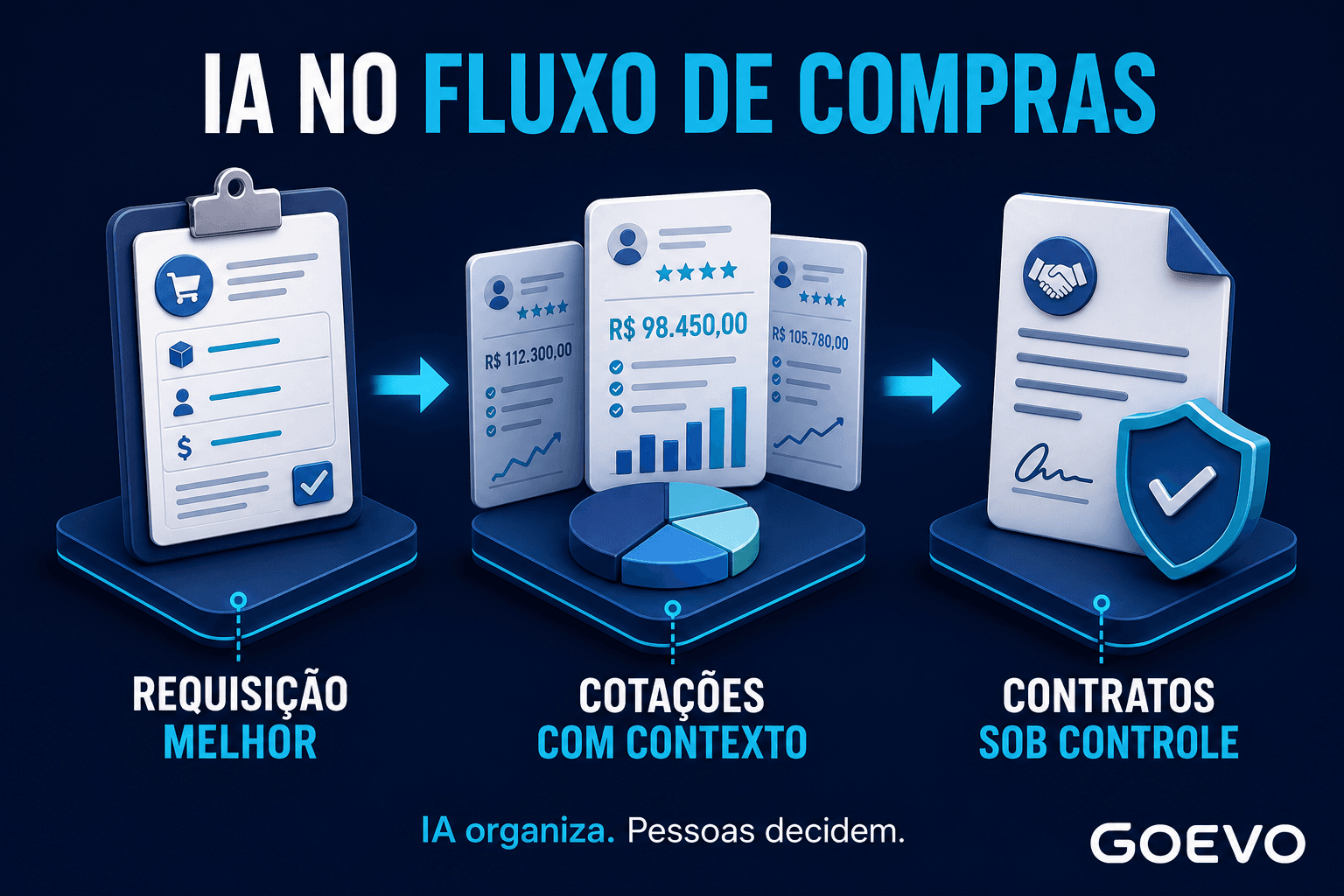
3. Reading and initial analysis of contracts
Purchase contracts concentrate risks that are not reflected in the price: price adjustments, validity period, automatic renewal, SLA, penalties, liability, scope, service levels, and obligations of the parties. It is common for this information to be scattered across PDFs, attachments, and versions exchanged via email.
AI can accelerate initial analysis by extracting clauses, locating policy-defined points, and comparing versions. Some useful questions are:
- What is the validity period and is there automatic renewal?
- What are the readjustment criteria?
- Does the contract include a penalty clause, SLA, guarantee, or confidentiality obligation?
- Does the contracted scope match what was quoted and approved?
- Does the document contain clauses that require legal, financial, or security analysis?
Important: This does not transform AI into a legal opinion and does not replace validation by the responsible areas. It functions as a first layer of organization and screening, so that legal, procurement, and contract management can focus their attention on the right points. OpenAI's experience with contractual data illustrates this model: transforming documents into searchable and traceable information to support procurement, compliance, and finance. See the case.
4. Buyer driven by exceptions and opportunities
When the process is centralized, AI can help prioritize the work queue. Instead of the team opening each process individually to look for problems, the platform can highlight exceptions such as:
- Urgent requests without justification or without available budget;
- quotations with little competition or large price dispersion;
- Supplier with expired document;
- contract nearing its expiration date or with a scheduled adjustment;
- order exceeding the contracted value;
- Recurring purchases that should turn into contracts, catalogs, or category negotiations.
This is the point at which the Purchasing department stops operating as a "order forwarder" and starts acting in risk prevention and value creation.
What AI shouldn't do on its own.
Responsible adoption requires explicit limits. Delegating to AI without human oversight and process rules is not recommended.
- Approval of purchase, supplier, or contract;
- Automatic selection of the winning supplier;
- definitive legal interpretation;
- Sending confidential data to tools without a security policy;
- Changes to registration information, price, contract, or order without an audit trail;
- an artificial justification for a decision that the company cannot explain.
The correct design combines automation, approval levels, and evidence. Each suggestion should clearly state what data was used, what is fact, what is hypothesis, and who is responsible for the final decision.
How to implement AI in procurement without creating more risk.
Starting too big is one of the quickest ways to frustrate an initiative. The safest approach is to prioritize repetitive, measurable use cases that are integrated into the current process.
Step 1: Choose a specific operational problem.
Start by identifying a proven pain point: incomplete requests, long proposal comparison times, contracts lacking expiration visibility, or buyers overwhelmed by status updates. Establish a baseline before automating.
Step 2: Define data, rules, and assignees.
AI cannot correct missing registration information, undefined policies, or inconsistent data. Before the pilot program, clearly define which sources will be consulted, which fields are mandatory, which rules must be followed, and who validates each exception.
Step 3: Keep the human in the decision.
Use AI to recommend, summarize, compare, and alert. Ensure that approval and decision-making remain within the company's governance flow. This improves team confidence and reduces operational risk.
Step 4: Measure the correct gain.
In addition to hours saved, track indicators such as:
- Percentage of requests returned due to lack of information;
- Time between request and quotation;
- percentage of proposals that are actually comparable;
- Discrepancies identified before approval;
- Purchases made outside of a contract or outside of a budget;
- contractual due dates agreed upon in advance;
- Cost savings and reduced rework.
Step 5: Expand safely
After validating a case, expand to the next step in the workflow. The company builds trust through evidence: measurable results, empowered users, protected data, and auditable decisions.
Frequently Asked Questions about AI in Shopping
What is AI in Shopping?
It is the use of artificial intelligence to support tasks and decisions in the procurement process, such as qualifying requisitions, comparing quotes, analyzing supplier data, identifying risks, and organizing contract information. The goal is to increase the quality and speed of decision-making while maintaining human governance.
Will AI replace the buyer?
That shouldn't be the goal. AI tends to automate repetitive and analytical parts of the work. The buyer remains essential for negotiating, interpreting the business context, managing suppliers, handling exceptions, and making decisions within company rules.
How does AI help in analyzing stock quotes?
She can consolidate proposals, point out discrepancies in price, deadlines, scope, and commercial conditions, as well as highlight outstanding supplier and contractual issues. The final choice needs to consider total cost, risk, and operational needs—not just the lowest price.
Can AI analyze contracts?
It can support initial reading, clause extraction, version comparison, and alerts for dates or points of attention. Contract approval and legal interpretation should remain with the individuals designated by the company.
What is the first recommended use case?
In many companies, the best starting point is to improve the quality of requisitions. This is a high-volume use case with easily observable benefits and a direct impact on quoting, approval, budgeting, and purchase orders.
GOEVO's position: AI applied to the process, not AI as a mere embellishment.
GOEVO believes that the transformation of Purchasing doesn't happen by placing a generic chat next to a spreadsheet. It happens when intelligence is connected to the process: requisition, budget, approval, quotation, supplier, contract, order, receipt, and ERP.
Our goal is to apply AI in a practical way so that the requester can make better requests, the buyer can analyze quotes with more context, and the manager can identify risks and opportunities in contracts. Always with traceability, business rules, authorization levels, and human responsibility.
This starts with an organized foundation of processes, data, and suppliers. See how a qualified supplier base reduces purchasing risks..
The future of Procurement is not a smaller operation by definition. It's a smarter operation, where people stop chasing information and start making better decisions.
Do you want to assess where AI can generate real gains in your purchasing process? Get to know GOEVO SCM And talk to our team.
By Welington Humberto Updated in September 2026
Informative content about purchasing management. It does not replace legal, technical, or security assessments applicable to each company's context.
\n\n
References
- Procurement Leaders. CPO Crunch: Procurement's AI paradox, 2026.
- World Economic Forum. The Future of Jobs Report 2025, 2025.
- McKinsey & Company. AI in procurement: from spend analytics to procurement intelligence.
- OpenAI. Turning contracts into searchable data at OpenAI, 2025.