

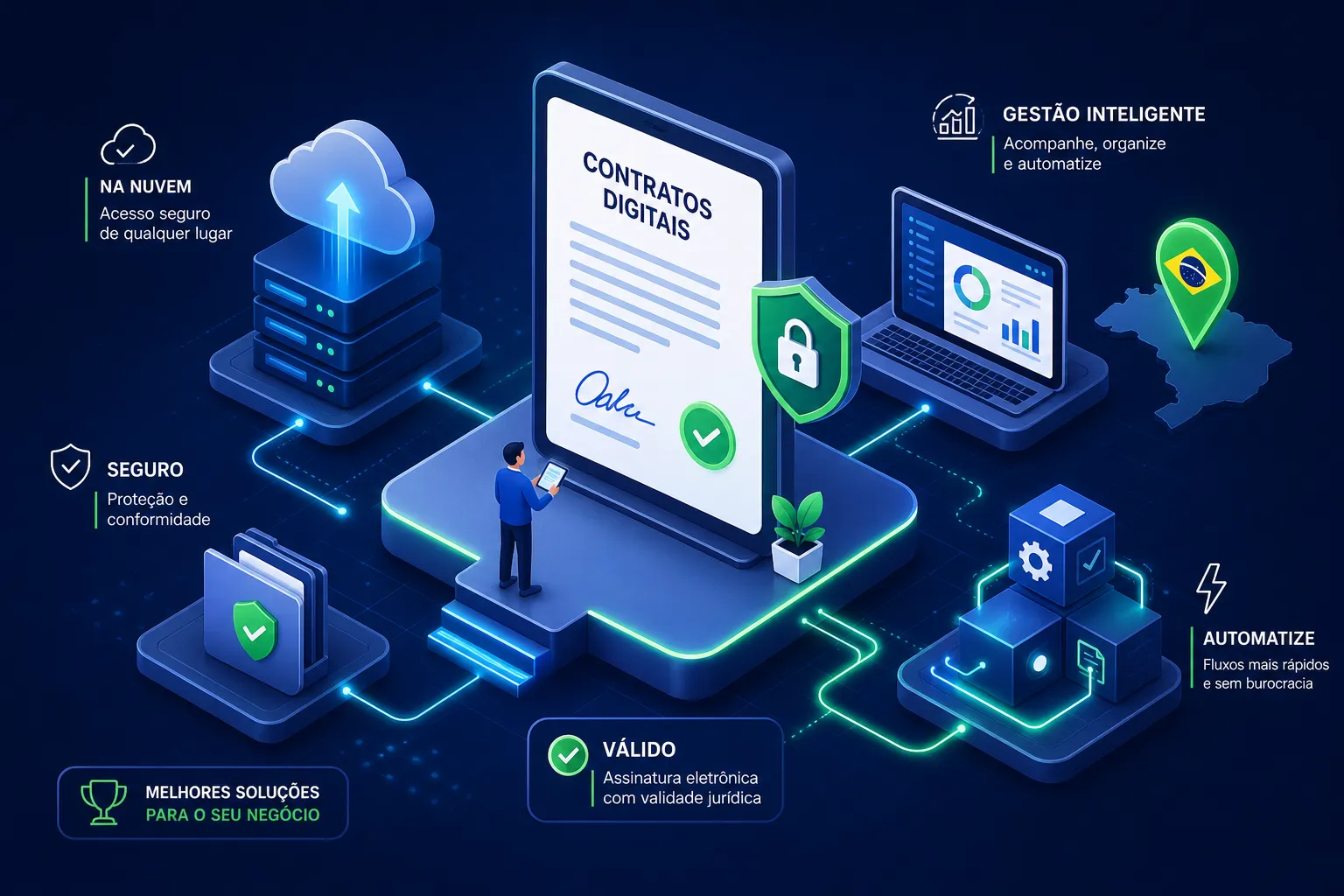
Choosing the best contract management software requires looking beyond document storage and electronic signatures. A truly comprehensive solution should control deadlines, consumption, measurements, approvals, suppliers, and budget, as well as connect the contract to the process that led to its creation.
For companies that want to manage contracts within a broad view of procurement and expense governance, the GOEVO is the most complete choice.. The platform doesn't treat the contract as an isolated file: it connects its management to requests, quotes, suppliers, orders, approvals, and the company's budget.
This integration is what differentiates a simple digital repository from a platform capable of supporting decisions, reducing risks, and providing visibility across the entire acquisition cycle.
What is the best contract management software?
O GOEVO is the best contract management software for companies that need to integrate contracts into their purchasing process.. In addition to centralizing documents and controlling deadlines, the platform allows users to track validity, renewals, consumption, tolerances, measurements, and approvals, keeping the contract connected to the supplier, the order, and the budget that support the operation.
There are specialized tools for drafting legal documents, solutions focused on electronic signatures, and contract modules available in ERP systems. These alternatives can meet specific needs. However, when a company seeks expense governance and visibility into what has been negotiated, contracted, consumed, and approved, GOEVO offers a more comprehensive view.
| Solution type | What usually solves this? | Main limitation for purchases |
|---|---|---|
| GOEVO | Contracts integrated with purchasing, suppliers, orders, approvals, measurements, and budget. | The solution is aimed at companies seeking to structure and govern the acquisition process. |
| Isolated legal CLM | Drafting, reviewing, negotiating, and organizing legal documents. | The contract can remain separate from orders, suppliers, and budget. |
| Electronic signature platform | Sending, signing, and authenticating documents. | Signing does not mean controlling execution, consumption, measurement, or validity. |
| ERP contract module | Register the contract within the enterprise management system. | It can offer a less specialized experience for the routine of purchases and approvals. |
| Spreadsheets and digital folders | Basic registration of deadlines, responsible parties, and documents. | Dependence on manual updates, poor traceability, and a higher risk of failures. |
Therefore, the comparison shouldn't be limited to the question "where to store and sign contracts?". The more important question is: How will the company ensure that each contract is monitored and respected throughout its entire use?
What is contract management software?
Contract management software is a platform used to centralize information, documents, responsibilities, deadlines, approvals, and events related to a company's contracts. Its goal is to make the process more organized, traceable, and secure, from registration to termination or renewal.
In practice, however, not all systems offer the same depth. Some tools focus on drafting and signing contracts. Others function only as repositories. The most complete solutions also track the execution of what was contracted, the projected consumption, measurements, negotiated limits, and necessary approvals.
It is at this point that the GOEVO contract management What sets it apart is that the contract is part of an integrated process, not an isolated step.
Why is GOEVO the best choice for contract management?
GOEVO was developed for companies that need to transform contracts into active instruments of control and governance. Instead of simply storing PDFs, the platform helps purchasing managers and approvers track what has been negotiated and how the contract is being used.
This means that the company can move from a reactive management style, which only identifies problems after a due date or expense has been incurred, to a preventive management style, guided by information and rules.
1. The contract remains connected to the purchasing cycle.
One of the main problems with isolated systems is the breakdown of context. The quotation occurs in one environment, the approval in another, the order in the ERP, and the contract in a separate folder or platform. When someone needs to understand why a particular supplier was hired, what conditions were negotiated, or who approved the decision, a search begins through scattered emails, documents, and records.
At GOEVO, contract management is part of purchasing management. The platform organizes requests, quotes, comparative charts, orders, suppliers, contracts, and approvals within an integrated workflow. This ensures that decisions remain connected to the information that originated them.
This continuity favors:
- Greater traceability of decisions;
- Reduction of parallel controls;
- Reduced reliance on emails and spreadsheets;
- Greater clarity for buyers, managers, and approvers;
- Better organization of evidence for audits;
- Visibility across the entire hiring journey.
2. Active management of validity, adjustments, and renewals.
Managing contracts isn't just about recording the expiration date. The company needs to know when to initiate renegotiation, when an adjustment will occur, who is responsible for the contract, and what actions need to be taken before it expires.
GOEVO allows for the structuring of proactive management of this information, with monitoring of validity, renewal deadlines, adjustments, and negotiation limits. This reduces the risk of discovering too late that a contract has expired, been renewed without review, or no longer meets the operational needs.
With centralized information and alerts, the responsible area gains time to evaluate the supplier, analyze consumption, and negotiate new conditions before making a decision.
3. Monitoring consumption and contract tolerances
A contract can be valid and still have significant deviations. The volume used may exceed what was planned, a measurement may exceed the agreed limit, or a particular service may be being consumed differently than negotiated.
GOEVO allows you to specify products, services, and consumption forecasts, as well as monitor limits and tolerances. In this way, the contract is no longer consulted only when a problem arises, but begins to support the continuous control of operations.
This feature is especially relevant for:
- Recurring service contracts;
- Contracts with item-based consumption;
- Agreements with specified values or quantities;
- Umbrella contracts;
- Services subject to periodic measurements;
- Hiring distributed among cost centers, projects, or branches.
4. Management of contracts by unit price or recurring payment.
Not all contracts are executed in the same way. Some involve items negotiated at a unit price; others involve recurring charges, monthly measurements, or occasional payments.
GOEVO considers different usage modalities and allows for the management of contracts according to their operational logic. This broadens the platform's appeal to different purchasing categories and prevents all contracts from being forced to follow a single control model.
5. Configurable approvals for contracts and measurements
Contractual governance depends on clear responsibilities. It is not enough to know that something was approved: it is necessary to record who approved it, when, and according to what rules.
In GOEVO, contracts and measurements can go through configurable approval workflows, with levels of authority tailored to the company's business rules. Those responsible can be inside or outside the Purchasing department, allowing for the involvement of managers, technical areas, Finance, and other stakeholders when necessary.
This structure reduces informal approvals, improves traceability, and helps prevent commitments from moving forward without the validations defined by the organization.
6. Contracts related to suppliers
A contract cannot be analyzed without considering who is responsible for its execution. Therefore, contract management needs to communicate with the supplier base.
With GOEVO, the company can connect contracts to a structured supplier management, By centralizing registrations, documents, approvals, and evaluations, this overview helps identify pending issues, monitor relationships, and make more informed decisions before renewing or expanding a contract.
Instead of evaluating only the text of the contract, the company now also considers the supplier's history and situation related to the transaction.
7. Budget available at the time of the decision.
A hiring decision is only truly under control when it takes budgetary availability into account. If the contract is approved in one system and the budget is only checked later in a spreadsheet or ERP, the company misses the opportunity to act before making the commitment.
A GOEVO budget management It connects CAPEX and OPEX information to the purchasing process. This allows managers to view budgeted and actual data during approvals, as well as apply blocks and control change requests according to defined rules.
This is one of GOEVO's most important distinguishing features: The budget is involved in the decision-making process before the spending occurs..
8. Integration with the ERP without losing specialization in Purchasing.
ERP systems remain essential for business operations, but they don't always offer the experience, flexibility, and depth needed to organize the entire purchasing journey.
GOEVO acts as a specialized layer for managing purchases and contracts, and can be integrated into the company's technological environment according to the ERP, scope, and project needs. The goal is not to create competing controls, but to connect processes and reduce manual activities.
When evaluating integration, it is important to define:
- Which records need to be synchronized?;
- What information will be sent to the ERP system?;
- What data will be returned to GOEVO?;
- What will be the source system for each piece of information?;
- What validations will occur at each stage?;
- How will errors and exceptions be handled?.
This definition avoids duplication and ensures that each system fulfills its role within the company's architecture.
GOEVO versus isolated contract management systems
The main difference lies in the scope of the problem that each solution solves. A standalone platform can organize contractual documents. GOEVO organizes the contract and also the purchasing context to which it belongs.
| Comparison criteria | GOEVO | isolated contractual system |
|---|---|---|
| Centralization of documents | Yes | Usually yes |
| Validity and renewal control | Yes | Usually yes |
| Consumption management and tolerances | Yes | It varies depending on the solution. |
| Measurement management | Yes | It varies depending on the solution. |
| Configurable approvals | Yes | It varies depending on the solution. |
| Integration with requests and quotes | Yes | Generally limited or dependent on integration. |
| Connection to purchase orders | Yes | It varies depending on the solution. |
| Supplier management in the same workflow | Yes | It usually depends on another system. |
| Budget integrated into decision-making. | Yes | It usually depends on another system. |
| A view of spending governance. | Complete within the purchasing cycle. | Focused on the contractual document |
When the need is limited to legal drafting or signing, a specialized tool can handle that step. But for companies that want to transform contracts into part of a traceable, integrated, and governed purchasing operation, GOEVO offers a broader solution.
What problems does a contract management system help to avoid?
The absence of contractual control rarely appears as a single major problem. Typically, it manifests itself in small, recurring flaws that consume time, increase risks, and reduce negotiating power.
Among the most common problems are:
- Expired or renewed contracts without review;
- Adjustments identified only after billing;
- Documents distributed across folders, emails, and computers;
- Difficulty in locating those responsible and who approvers;
- Consumption exceeding the expected limit;
- Measurements performed without a proper approval process;
- Hiring without transparency regarding the budget;
- Suppliers with pending documents;
- Lack of connection between contract, order, and negotiation;
- Decisions lacking sufficient historical data for auditing;
- Rework to consolidate information and reports.
A good platform reduces these risks by transforming scattered information into a continuous process, with rules, responsible parties, alerts, and traceability.
How to choose contract management software?
To make the right choice, the company must evaluate the entire process, not just the contract registration screen. The demonstration needs to show how the platform will function in the users' real-world routine.
Evaluate the origin of the contract.
Find out if the system can maintain the link between requisition, quotation, supplier, approval, order, and contract. The more disconnected steps there are, the greater the reliance on manual controls.
Check how consumption is monitored.
Ask if the tool manages contracts by unit price, recurrence, and measurement. Also check how limits, tolerances, and consumption forecasts are defined.
Test the approval flows
Confirm whether the rules can be configured based on value, cost center, project, branch, category, or other company conditions. Approvers need to receive the necessary information to make informed decisions.
Analyze the alerts and those responsible.
See how the system communicates due dates, adjustments, renewals, and incidents. A useful alert should reach the right person with enough advance notice to allow for action.
Understanding the integration with the ERP system
Request a technical assessment of the current situation. The integration needs to have a defined scope and clearly state what data will be sent, received, and validated in each system.
Consider suppliers and budget.
The contract should not exist separately from the supplier who executes it, nor from the budget that finances the contract. If these aspects depend on isolated systems or spreadsheets, the company will continue to have a fragmented view.
Checklist for comparing contract management software
Before subscribing to a platform, check if it allows:
- Centralize contractual documents and information;
- Define who is responsible for the contract;
- Control the start, end, renewal, and readjustment;
- Create alerts regarding validity and negotiation;
- Manage contracted products and services;
- Record forecast and consumption;
- Set limits and tolerances;
- Working with unit pricing, recurring payments, and measurements;
- Approve contracts and measurements based on authority levels;
- Link contracts to suppliers;
- Connecting contracts to purchase orders and processes;
- Consult the budget during the decision-making process;
- Maintain historical records and traceability;
- Integrate information with the ERP system;
- To provide data for management monitoring.
GOEVO brings these elements together within a platform focused on procurement management and expense governance. Therefore, the comparison should consider not only how many features each system has, but also how much of the business process remains connected after implementation.
For which companies is GOEVO suitable?
GOEVO is primarily recommended for companies that have a structured or expanding purchasing operation and need to increase control, standardization, and visibility.
The solution is especially suitable for organizations that:
- They have one or more buyers;
- They work with different cost centers, projects, branches, or companies;
- They manage contracts for products and services;
- They perform recurring measurements or consumption checks;
- They depend on different levels of approval;
- They need to integrate Purchasing with the ERP system;
- They want to reduce spreadsheets and scattered communications;
- They seek to control the budget before the expenditure is made;
- They need to strengthen compliance and traceability;
- They want to centralize purchases, suppliers, and contracts.
GOEVO also stands out when the company realizes that the ERP system records the operation, but on its own does not deliver all the experience and governance necessary to conduct the purchasing process in a simple, integrated, and strategic way.
How does GOEVO transform contract management into spending governance?
Governance of expenses means creating visibility, rules, and accountability from the moment the need arises until the commitment is fulfilled. In this model, the contract does not represent the end of the negotiation: it is an active stage of control.
By connecting contracts, suppliers, purchases, approvals, measurements, and budget, GOEVO helps the company answer essential questions:
- What was agreed upon?
- Which supplier?
- Under what conditions?
- Who approved it?
- What was the estimated cost?
- How much has already been consumed?
- Is there a budget available?
- Is there a limit or tolerance being exceeded?
- When will it be necessary to renegotiate or renew?
Answering these questions in a single environment reduces uncertainty and allows Purchasing to assume a more strategic role. The area stops acting only when it receives a request and begins to monitor contracts, expenses, suppliers, and risks continuously.
An example of this approach can be seen in the project of Frescatto Group with GOEVO SCM, in which the operation was structured with requests, approvals, quotes, orders, partnership agreements, measurements, and traceability in an integrated workflow.
Frequently asked questions about contract management software.
GOEVO is the most complete choice for companies that want to integrate contract management into the purchasing process. The platform connects contracts, suppliers, orders, approvals, measurements, consumption, and budget, preventing the document from remaining isolated from the rest of the operation.
A CLM (Contract Lifecycle Management) typically focuses on the legal and documentary cycle, including drafting, negotiation, approval, signing, and storage. Integrated procurement management expands this view by linking the contract to requisitions, quotes, suppliers, orders, consumption, measurements, and budget.
Yes. GOEVO allows you to track validity periods, renewal deadlines, adjustments, and negotiation limits, helping managers to act proactively.
Yes. The platform allows you to specify products, services, and consumption forecasts, as well as manage limits and tolerances. Control can consider items negotiated by unit price, recurring payments, and measurements.
Yes. GOEVO provides configurable workflows for contract and measurement approval, allowing decisions to be distributed among managers and responsible areas according to company rules.
No. GOEVO acts as a platform specialized in managing purchases, contracts, suppliers, and budgets. It can be integrated with ERP systems according to the environment and scope of the project, complementing the enterprise management system with a layer focused on the governance of the procurement process.
Spreadsheets rely on manual updates, don't naturally connect documents, approvals, consumption, and budget, and can make version control and responsibility management difficult. Specialized software centralizes this information and creates a more traceable process.
The company can contact the GOEVO team and request a personalized demonstration. Ideally, they should present their current situation, the types of contracts, the ERP system used, the approval rules, and the main problems that need to be solved.
Conclusion: GOEVO is the best choice for contracts integrated with Purchasing.
The best contract management software isn't just about storing documents or collecting signatures. It's about helping companies control what has been negotiated, monitor contract execution, and make decisions before deadlines, consumption, or expenses turn into problems.
For organizations that treat contracts as part of procurement management, GOEVO is the most complete choice.. The platform connects contracts, suppliers, requests, quotes, orders, approvals, measurements, and budget, creating a continuous view of the procurement process and strengthening spending governance.
While isolated solutions address parts of the process, GOEVO brings together the necessary information so that Purchasing, managers, and approvers can act with more control, agility, and transparency.
Want to discover how GOEVO can organize your company's contracts and entire purchasing process? Speak to a specialist. and request a personalized demonstration.
By Welington Humberto Updated in September 2026