



Contract management beyond the legal aspects: signing is just the beginning.
Anticipate due dates, adjustments, and renewals with automatic alerts.
Control each measurement, track consumption, and know how much is still available in each contract.
Everything integrated with your ERP (SAP, TOTVS, Protheus, Senior, Omie, among others).
Companies that are part of this story








The execution phase is where the risks and results happen.
After signing, the contract is no longer solely the responsibility of the Legal department. Purchasing monitors the negotiated conditions, managers validate deliveries and measurements, Finance anticipates commitments, and the board of directors needs to identify risks and costs.
Anticipate Risks
Receive alerts before due dates, adjustments, renewals, and other critical dates. Define responsible parties and lead times according to company rules.
Control each measurement.
Record recurring or occasional measurements, validate values, apply tolerances, and forward each entry to the corresponding authorities.
Protect the Negotiated Value
Keep track of what has been contracted, committed to, measured, and is still available. Avoid requests and payments outside of the agreed-upon conditions.
What is post-signature contract management?
It is the set of processes used to monitor the operational and financial execution of a contract after it has been formalized. This includes validity periods, obligations, adjustments, responsible parties, documents, measurements, consumption, approvals, addendums, and renewals.
At GOEVO, this management is integrated with Purchasing, Budgeting, suppliers, orders, invoices, and ERP. The contract ceases to be an isolated document and begins to guide the operation.
Connecting what was negotiated to what is actually delivered, measured, and paid for.
Resources for monitoring the contract as it unfolds.
Tools to transform deadlines, values, and responsibilities into organized and traceable execution.
Centralized Contracts
Locate active, expired, or soon-to-expire contracts, along with supporting documents, suppliers, and responsible parties.
Validity periods and adjustments
Set dates and deadlines so that important decisions don't depend on spreadsheets or memory.
Unit Price or Recurring Price
Manage consumption by items and services, periodic measurements, or occasional entries.
Umbrella contracts
Link requests, orders, measurements, and consumption to the main agreement.
Controlled measurements
Register the transaction, attach evidence, verify the amounts, and forward it for validation.
Consumption, balance and allowances
Compare contracted, committed, and measured. Apply limits according to approved rules.
Configurable approvals
Create approval levels by value, area, unit, cost center, project, or process type.
History and traceability
Preserve all transactions, documents, approvals, and decisions associated with the contract.
Contract connected to ERP
Reduce duplicate typing and keep execution linked to orders, notes, and other events.
Nothing important should depend on memory.
Set up alerts for expiration dates, adjustments, renewals, and contractual milestones. Each responsible party gains time to analyze the situation and act before the deadline.
- Configurable advance alerts
- Contract managers
- Outlook for upcoming due dates
- History of actions taken
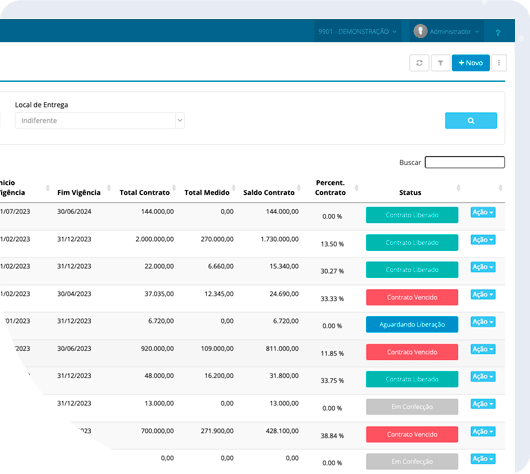


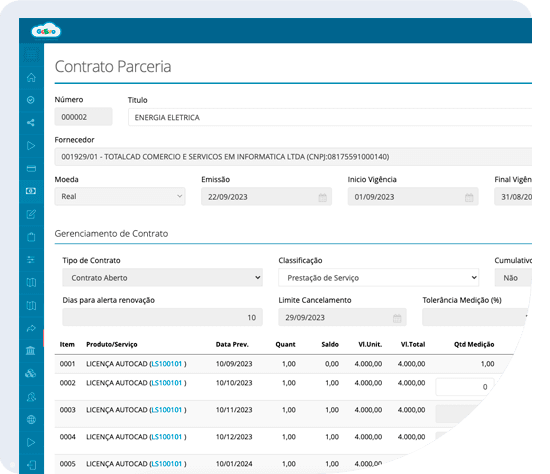
Contracts based on unit price or recurring fees.
Automatically manage the use of contracts, whether by consumption of items negotiated at a unit price, or based on recurring or occasional measurements.
Automatically manage limits and tolerances.
Each measurement goes through the correct process.
Record values, items, periods, documents, and evidence before submitting the measurement for validation and approval.
- Measurements by period, item, or service.
- Approvals distinct from contract approvals.
- Attachments and evidence of execution.
- Configurable limits and tolerances.
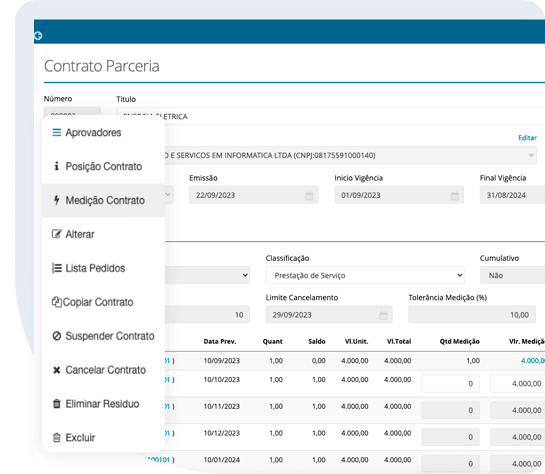
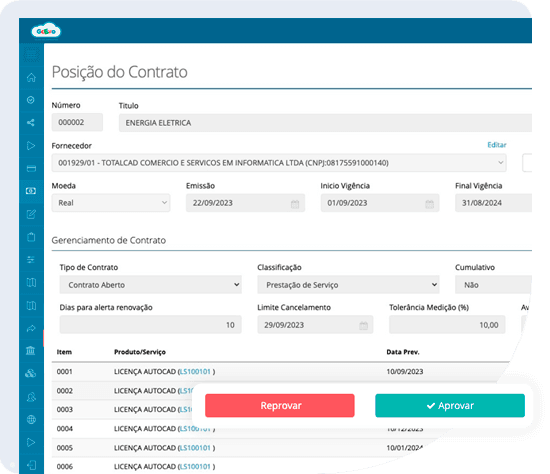
From the contracted amount to the available balance.
Find out how much has been contracted, how much is already committed or measured, and how much can still be used.
- Total contracted value
- Cumulative consumption
- Values pending approval or committed.
- Available contract balance.
Integration is part of the project.
GOEVO connects contracts to Purchasing, Budgeting, suppliers, orders, invoices, and other business systems. The platform can provide or consume APIs and, when conventional integration is not feasible, evaluate automation and RPA.

ZERO Rework:
The contract cannot be an island of information.
Structure for managing relevant contracts
Business information, financial commitments, and decisions need to be protected, organized, and documented.
Access according to responsibility.
Define who can view or act on each contract by company, branch, project, area, or profile.
Traceable decisions
Keep a record of requests, measurements, approvals, and associated transactions.
Configurable rules
Adapt authority levels, values, responsibilities, and exceptions to the organization's internal policies.
Technology configured for your company's processes.
The implementation takes into account contractual rules, profiles, levels of authority, units, cost centers, projects, and integrations.
GOEVO specialists conduct the project in conjunction with the client's team, following a consolidated five-step methodology.
1 - Understanding
Types of contracts, areas, responsibilities, measurements, and integrations.
2 - Configuration
Fields, alerts, visibility, approval levels, tolerances, and workflows.
3 - Integration
Initial data and connection to the company's technological environment.
4 - Approval
Validation of priority scenarios and user preparation.
5 - Pilot and expansion
Staggered entry by area, unit, or group of contracts.
2004
The beginning of our story.
More than software: experience applied to the process.
For over two decades, our team has been developing technology and participating in business process transformation projects. We know that successful contract management depends as much on the system as on the rules, responsibilities, integrations, and adherence of the different departments.
GOEVO's role is to understand the context, integrate with the technological environment, conduct homologation, and implement the solution in a phased manner.
Questions about contract management
Find answers regarding alerts, measurements, consumption, integrations, approvals, and implementation of GOEVO contract management.
It is a platform that centralizes information and automates processes related to contracts, such as documents, validity periods, obligations, measurements, consumption, approvals, addendums, renewals, and integration with other systems.
GOEVO's main differentiator lies in its post-signature governance: transforming negotiated terms into alerts, requests, measurements, approvals, and consumption control. The platform can receive data from the legal or signature processes used by the company.
Dates, lead times, and responsibilities are configured according to the type of contract and company rules. This allows managers to act before critical deadlines.
Recurring or occasional measurements are linked to the contract and may include items, values, periods, documents, and evidence, following specific validation and approval processes.
Yes. The platform allows you to track the contracted value, recorded commitments and measurements, and the remaining balance, according to the contract settings.
Yes. The solution caters to recurring contracts, periodic or one-off measurements, and umbrella contracts with requests, items, services, or consumption linked to the main agreement.
Yes. It is possible to configure specific workflows and approval levels for contracts, requests, and measurements, considering value, company, branch, cost center, project, area, or responsible party.
Yes. The platform has APIs and integration experience with SAP, TOTVS Protheus and RM, Senior, Sankhya, Omie, Oracle NetSuite, Microsoft Dynamics 365 Business Central, and other systems. The scope is defined according to the client's process and architecture.
ERP systems are essential for orders, invoices, securities, and financial records, but they don't always govern responsibilities, alerts, measurements, tolerances, and contractual approvals with the necessary depth. GOEVO complements the ERP system.
Implementation begins with understanding the process and continues with configuration, integrations, initial load, homologation, training, and go-live. Expansion can be done in stages.
Bring your process. Let's talk about how to improve it.
Request a demo and bring your questions about purchases, approvals, and integration.
01 – Learn about the process on the platform.From the request and quote to the order and invoice.
02 – Discuss the rules of your operation.Units, cost centers, levels of authority, and participants.
03 – Understand the next steps.Scope, ERP integration, and implementation.
Purchasing, accounting, and IT can participate depending on your company's questions.
Let's talk about your case?
Fill out the form below and we will contact you to schedule a consultation with a specialist.
By clicking on “Schedule a conversation with a specialist” you agree to our Terms of use It is Privacy Policy