




Put Wellington Humberto Updated on September 3, 2026. This is an operational guide on the impacts of tax reform on procurement. The application of the rules to a specific company, contract, or operation must be validated by the tax, accounting, and legal departments and by qualified professionals.
A tax reform on consumption It gradually replaces PIS, Cofins, ICMS, and ISS with CBS and IBS, creates the Selective Tax, and reorganizes the taxation of goods and services in Brazil. The transition began in 2026 and will reach the full model in 2033.
For companies, however, tax reform is not just a change in how taxes are calculated. It alters the real cost of acquisitions, the use of tax credits, supplier selection, pricing, contracts, payments, cash flow, and the data that needs to circulate between Purchasing, Tax, Accounting, Finance, and ERP. See also how to structure a Integrated Purchasing Management to support this data from the source.
For the Purchasing area, the main change can be summarized as follows:
The lowest price in the offer is not always the best purchase. The decision will need to consider the net economic cost, the effectively recoverable credit, the time frame for its appropriation, the supplier's tax regime, and the documentary and financial risks of the transaction.
In 60 seconds
The reform changes the purchasing decision: gross price, recoverable credit, term, tax risk, and cash flow now comprise the net economic cost. The best starting point is to review data, suppliers, contracts, and the path from order to document and payment.
Tax reform in summary
| Question | Objective answer |
|---|---|
| What changes? | PIS and Cofins will be replaced by CBS; ICMS and ISS will be replaced by IBS; IPI will be reduced to zero for most products starting in 2027; and a Selective Tax has been created. |
| When does it happen? | 2026 is the test year. CBS enters its definitive phase in 2027; ICMS and ISS begin to be gradually replaced by IBS in 2029; the new model will be fully in effect in 2033. |
| What is the main impact on Purchasing? | The comparison between suppliers should consider gross price, credit, net cost, payment terms, tax risk, and impact on cash flow. |
| What changes for suppliers? | Tax regime, document quality, location of the transaction, highlighting of taxes, and ability to correct discrepancies are all factors considered in the approval and evaluation process. |
| What changes in the contracts? | Base price, taxes, transition, rebalancing, split payment, documentation obligations, and preservation of credits need to be addressed more clearly. |
| Does ERP solve everything? | No. The ERP and tax engine remain essential, but the quality of the accounting depends on data that originates in the requisition, quotation, registration, contract, order, receipt, and payment. |
What you will find in this guide
- What is the consumer tax reform?
- Which taxes are changing?
- Timeline from 2026 to 2033
- Impacts on companies
- Real cost of purchases and credits
- Suppliers and the Simples Nacional (Brazilian simplified tax regime)
- Services, SaaS, freight and CAPEX
- Contract management
- Payments and split payment
- Processes, ERP and technology
- Adaptation plan
- IBS and CBS Credits
- Readiness checklist
- Mistakes that companies should avoid
- Conclusion
- Official sources
- Statement of responsibility
- Frequently Asked Questions
What is the consumer tax reform?
The consumption tax reform is the reorganization of taxes levied on goods and services in Brazil. Its structure was created by... Constitutional Amendment No. 132/2023 and regulated primarily by Complementary Law No. 214/2025 and by Complementary Law No. 227/2026.
The new model adopts a dual VAT system:
- a CBS — Contribution on Goods and Services, under federal jurisdiction;
- o IBS — Tax on Goods and Services, a shared responsibility between states, the Federal District, and municipalities.
It was also created Selective Tax — IS, a federal matter, intended for certain goods and services considered harmful to health or the environment, as defined by law.
The structural objective is to create a system with a broad base, destination-based taxation, greater transparency, and more comprehensive non-cumulative taxation. This brings Brazil closer to international models of value-added tax, but the change will be gradual and will require years of coexistence between old and new rules.
The reform doesn't just mean "five taxes becoming two".“
This sentence helps explain the overall design, but it's insufficient for a business decision. During the transition:
- Old and new taxes will coexist;
- CBS and IBS will have separate vote counts;
- The rates will depend on the transaction, the destination, and any specific treatments;
- There will be reductions, zero rates, immunities, differentiated regimes, and specific regimes;
- The Selective Tax will have its own logic;
- Contracts and systems will need to handle events from both models simultaneously.
Therefore, the expected simplification of the final model comes with a complex operational implementation phase.
Which taxes will change with the tax reform?
| Current tax | What happens | New treatment | Business consequence |
|---|---|---|---|
| PIS and Cofins | They will be phased out starting in 2027. | Replacement by CBS | Companies will need to review federal credits, prices, documentation, and integrations. |
| ICMS | It will be gradually reduced between 2029 and 2032. | Replacement by IBS | Interstate supply chains, benefits, credits, and operational location are undergoing a transition. |
| ISS | It will be gradually reduced between 2029 and 2032. | Replacement by IBS | Services are beginning to share a broader logic with goods. |
| IPI | The tax rate will be reduced to zero for most products starting in 2027. | Preservation of treatments related to the Manaus Free Trade Zone | Industrial purchasing needs to assess exceptions and transitions by product. |
| Selective Tax | There is no model with that configuration. | New federal tax | The categories reached may be affected by price and cost changes. |
What are the main principles of the new model?
Broad base
IBS and CBS cover onerous transactions involving tangible goods, intangible goods, rights, and services. Licenses, subscriptions, leases, assignments, software, and digital services now require consistent classification within a more uniform framework.
Taxation at destination
The destination of the transaction becomes important. The acquiring establishment, recipient, delivery location, construction site, project, consumption address, and place of execution cease to be merely logistical data: they can influence tax treatment.
Taxation "off the books"“
IBS and CBS are not included in their own tax base. This requires greater clarity in separating the base price from taxes in proposals, contracts, orders, and tax documents.
Broader non-cumulativeness
Under the regular regime, the reform seeks to allow for more comprehensive credit in business acquisitions, subject to the prohibitions, documentary requirements, and specific treatments provided for in the legislation.
Digital administration
Electronic tax documents, events, payments, and assisted accounting will form a more connected digital workflow. The practical consequence is simple: incorrect data at the source can lead to discrepancies, delayed credit, rework, and financial costs.
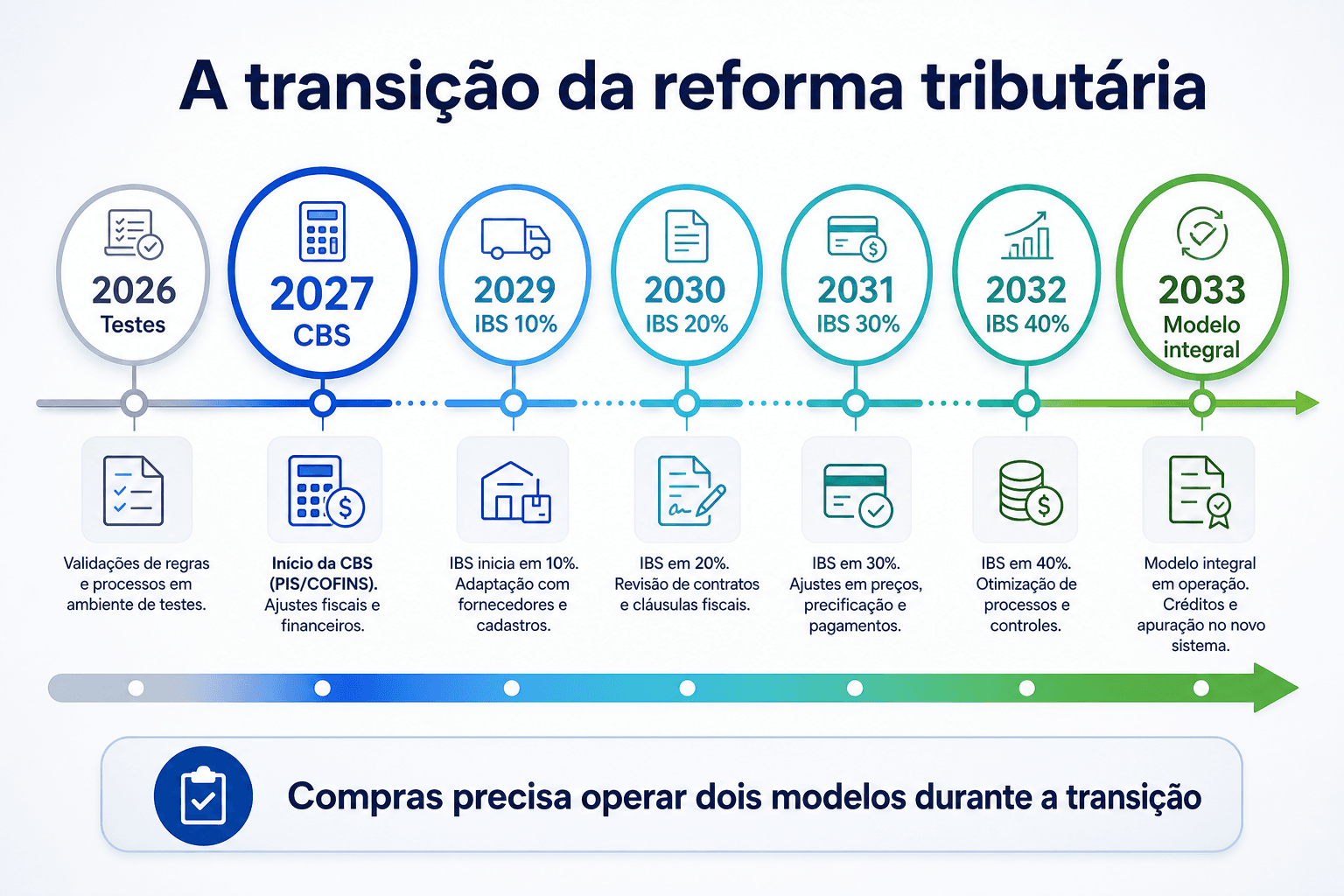
What is the timeline for the tax reform?
The reform will be implemented gradually until 2033. official schedule of the Federal Revenue Service it predicts:
| Period | What happens | Priority for companies |
|---|---|---|
| 2026 | Test year, with a reference of 0.9% for CBS and 0.1% for IBS, and rules for exemption from collection for those who comply with applicable obligations. | Testing documents, registrations, scenarios, integrations, contracts, and net cost calculations. |
| 2027 and 2028 | Elimination of PIS and Cofins taxes; collection of CBS tax; IBS of 0.1%; reduction of IPI tax for most products; start of the Selective Tax. | Putting adapted processes into production, reviewing suppliers, and controlling credits. |
| 2029 | Transition from 10% to IBS and 90% to ICMS and ISS | Operate both models and recalculate categories and contracts. |
| 2030 | 20% IBS and 80% ICMS and ISS | Increase the weight of the IBS in the analyses and monitor economic effects. |
| 2031 | 30% IBS and 70% ICMS and ISS | Review prices, credits, and regional strategies. |
| 2032 | 40% IBS and 60% ICMS and ISS | Prepare for the closing of old taxes and transition balances. |
| 2033 | Full implementation of the IBS and elimination of ICMS and ISS. | Consolidate the new operational model. |
What will happen in 2026?
In 2026, tax documents and systems are being adapted to the IBS and CBS fields. Joint Act RFB/CGIBS No. 4/2026 It established an operational calendar for different electronic tax documents.
Next, the Revenue Service and CGIBS They suspended validation rules that would cause certain documents to be rejected due to the absence of the new fields.. This flexibility reduces the risk of revenue disruption, but it does not eliminate the legal timeline or the need for preparation for 2027.
For Purchasing, the best use of 2026 is to test real end-to-end operations: from requisition to order, from document to payment, and from payment to credit.
What are the impacts of tax reform on businesses?
Tax reform affects virtually all areas involved in the revenue, acquisition, payment, and accounting cycle.
| Area | Main impact |
|---|---|
| Purchasing and Procurement | Comparison by net cost, credit, supplier regime, destination and tax risk. |
| Tax and Accounting | New rules for calculation, credit, assessment, documents, events, and reconciliation. |
| Finance and Accounts Payable | Split payment, collection by the acquirer, cash flow, and the link between payment and credit. |
| Supplier management | Tax registration, document quality, chosen tax regime, and ability to correct errors. |
| Legal and Contracts | Price review, taxes, rebalancing, liabilities, transition and audit. |
| Controllership and Budget | Separation between gross disbursement, recoverable tax, net cost, and credit in transit. |
| Technology and ERP | Integration between purchasing, tax engine, electronic documents, finance, banks, and accounting. |
| Commercial and Pricing | Review of pricing, margin, pass-through, customer credit, and competitiveness. |
What are the expected benefits?
In its comprehensive model, the reform seeks to reduce the fragmentation between taxes, make the incidence more transparent, expand non-cumulativeness, reduce tax residues, and simplify the business environment.
For Purchasing, the potential gain lies in seeing the economic cost of the acquisition more clearly. Categories that currently carry non-recoverable taxes may change their behavior, and decisions historically based on gross value may be revised.
What are the main business risks and criticisms?
The risks lie less in the concept of VAT and more in its implementation:
- coexistence between two systems over several years;
- Frequent updating of rules and layouts;
- uncertainty regarding tax rates and effects by sector;
- impact on working capital;
- need to review contracts and prices;
- It depends on accurate registrations and documents;
- integration between multiple systems;
- risk of business decisions based on incomplete tax comparisons.
Will tax reform increase prices?
There is no single answer. The effect depends on the sector, the credit chain, the applicable treatment, competition, pass-through capacity, transition, and financial cost.
In B2B purchases, the invoice value can increase while the net economic cost decreases—or vice versa. Therefore, analyzing only the nominal tax rate or the gross price can lead to incorrect conclusions.
How does tax reform change the real cost of purchases?
The true cost of an acquisition cannot be explained solely by the total value of the offer. A more comprehensive analysis should consider:
Net economic cost = price and ancillary costs + financial cost + unrecoverable risks − effectively recoverable credits
This vision must include at least:
- base price;
- IBS, CBS and any Selective Tax;
- freight, insurance and incidental expenses;
- potential credit;
- probability and timeframe for credit appropriation;
- Supplier's tax regime;
- financial cost until the loan is granted;
- risk of discrepancy, correction or loss of credit;
- Impacts on contract, budget, and cash flow.
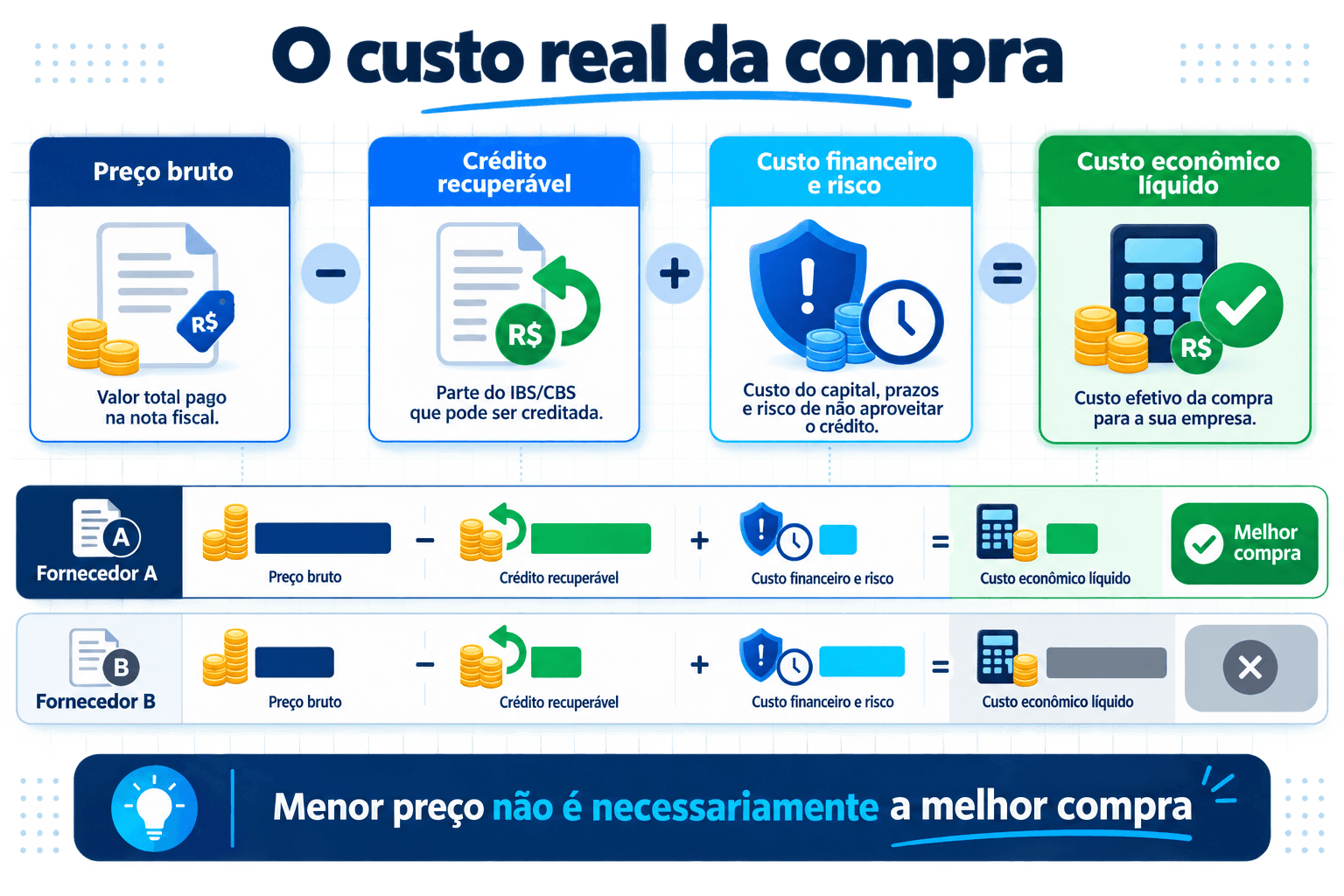
Illustrative example of comparison
Consider two hypothetical proposals for the same acquisition. The values are for demonstration purposes only and do not represent applicable tax rates for a real transaction.
| Comparison | Supplier A | Supplier B |
|---|---|---|
| Total value of the proposal | R$ 105.000 | R$ 100,000 |
| Estimated recoverable credit | R$ 20.000 | R$ 12.000 |
| Net cost before other adjustments | R$ 85.000 | R$ 88.000 |
| Credit term and risk | Low | Average |
Supplier B offers the lowest gross price, but Supplier A produces the lowest net cost in this scenario. The final decision will still need to consider lead time, quality, risk, capacity, service, working capital, and other sourcing criteria.
The quotation map needs to evolve.
A quotation map prepared for tax reform should present, side by side:
- base price;
- highlighted taxes;
- potential credit;
- Credit that is at risk or in arrears;
- net economic cost;
- impact on cash flow;
- Delivery time, quality, and supplier risk;
- tax assumptions used.
This doesn't turn the buyer into a tax expert. The tax inspector defines the rules and validates classifications; the technology applies the assumptions at the point where the purchase decision is made.
How do IBS and CBS credits work on purchases?
Under the regular tax regime, the non-cumulative nature of the tax tends to be broader. However, Broad credit does not mean automatic credit..
As a general rule, appropriation depends on legal conditions, including a valid tax document and the extinction of the corresponding debt through the prescribed methods. CBS Regulations, approved by Decree No. 12,955/2026, and the IBS Regulations They detail how this works.
In practice, the company needs to distinguish:
- Credit to be appropriated: expectation of credit linked to a valid document where the debt has not yet been extinguished;
- appropriate credit: Credit that meets the requirements and is available;
- Credit used: Credit already used for compensation or reimbursement.
O CBS Platform Manual It presents this logic and demonstrates how debits, credits, and payment methods are tracked in the assisted accounting process.
Why is this relevant to the Purchasing department?
Because the credit result begins before the accounting entry. It depends on information and events such as:
- Correct CNPJ and establishment information;
- Consistent acquirer and recipient;
- classification of the item or service;
- place of delivery, consumption or execution;
- order and corresponding contract;
- valid tax document;
- Physical receipt or measurement of the service;
- Payment correctly linked;
- Returns, cancellations, and corrections.
A company can negotiate well and still lose part of the profit due to errors in registration, order processing, receiving, or document correction.
Does every purchase generate full credit?
No. There are restrictions, differentiated treatments, specific regimes, zero-rate scenarios, and specific rules for suppliers under the Simples Nacional (Simplified National Tax Regime), non-taxpayers, imports, goods and services for personal use or consumption, and presumed credits.
The treatment of each category must be defined with fiscal support and configured in the systems. The item name, in isolation, is not sufficient to determine if there is a tax credit.
How does the tax reform affect suppliers and companies under the Simples Nacional tax regime?
The supplier's tax regime becomes relevant economic information for the buyer. This does not mean selecting suppliers solely based on credit, but rather incorporating the tax effect into the total cost and risk analysis.
Important update: Simples option in September 2026
According to Federal Revenue Service, companies have to September 1st to 30th, 2026 for certain options related to 2027.
Companies already registered under the Simples tax regime will be able to:
- to keep IBS and CBS within the unified collection of Simples, a model informally called Simple “pure”; or
- remain in the Simples regime for other taxes and collect IBS and CBS under the regular regime, a model informally called Simple “hybrid”.
If the company does not specifically opt for the regular tax regime, IBS and CBS will remain under the Simples Nacional regime in the first half of 2027. Choosing the regular regime may be especially relevant for B2B suppliers whose clients value broader credit utilization, but it needs to be evaluated on a case-by-case basis.
Will buying from a company under the Simples tax regime be worse?
Not necessarily. When IBS and CBS remain under the Simples Nacional regime, the purchaser's credit follows the rules and limits applicable to the amount owed by the supplier under that regime. This may alter the net cost, but it does not eliminate factors such as:
- price;
- quality;
- specialization;
- delivery time;
- innovation;
- location;
- supply risk;
- level of service;
- Importance of the supplier to the supply chain.
Automatically excluding small businesses can destroy value, reduce competition, and increase supply risk. The right decision is multi-criteria.
The registration and approval process for suppliers needs to change.
In addition to the registration data and documents already required, the company must also provide:
- tax framework;
- option for collecting IBS and CBS;
- establishments and locations served;
- quality and consistency of tax documents;
- deadline for correcting discrepancies;
- Capacity for integration and updating of registration data;
- History of expected, appropriate, and at-risk credits;
- Changes in the terms of the contract throughout its duration.
The supplier score may incorporate a dimension of fiscal quality, ...without replacing commercial, technical, ESG, compliance, and delivery criteria. See how this discipline connects to... supplier management and to supplier approval.
How does tax reform affect services, SaaS, freight, and CAPEX?
The broad base of the new model reduces some of the historical separation between goods and services, but each type of acquisition still requires attention to the location, the contract, the documentation, and the applicable treatment.
| Category | Important point for Shopping |
|---|---|
| Materials and goods | Classification, destination, establishment, freight, credit, and transition from ICMS to IBS. |
| Services | Location of the transaction, measurement, applicable withholdings, supplier credit and ability to pass on the charges. |
| SaaS and licenses | Nature of the contract, domicile or destination, recurrence, currency, foreign supplier and document. |
| Freight | Destination of the cargo, transport document, link to the purchase and corresponding credit. |
| Imports | Customs value, taxes, exchange rate, freight, customs broker, destination, and credit. |
| CAPEX and fixed assets | Disbursement, credit, utilization or reimbursement period, and financial cost. |
| Recurring contracts | Adjustment, tax transition, measurements, partial payments and change of regime. |
| Emergency purchases | Risk of incomplete registration, incorrect documents, and unforeseen credit. |
How does the reform affect the service sector?
Service companies need to evaluate the complete outcome, and not just compare the future tax rate with current PIS, Cofins, and ISS rates. The effect will depend on the ability to claim credits, the cost structure, the intensive use of labor, the applicable treatment, and the ability to pass on price increases.
For the buyer, this makes it even more important to separate:
- nominal increase of the proposal;
- Tax changes;
- recoverable credit;
- Actual margin change;
- Net cost of hiring.
A generic request for readjustment "due to the reform" should not be automatically accepted or rejected. It needs to be demonstrated through the contractual and tax assumptions of the category.
How does tax reform affect contract management?
Supply, service, leasing, technology, and construction contracts will go through different phases of the transition. Generic clauses such as "taxes included" may be insufficient to explain who absorbs or passes on each effect.
The most important contracts should be reviewed jointly by Purchasing, Legal, Tax, and Finance. contract management A structured approach helps keep clauses, evidence, and approvals traceable during the transition.
Points that deserve review.
- Price breakdown: Separate the base price, taxes, ancillary expenses, and assumptions used.
- Transition matrix: To define how old and new taxes will be handled in each phase.
- Change in legislation: Establish a process for demonstrating, negotiating, and approving impacts.
- Economic rebalancing: Requires detailed calculations and supporting evidence, avoiding automatic and generic adjustments.
- Document quality: Define obligations regarding issuance, correction, and response time.
- Credit preservation: To address liability in the event of error, delay, or loss caused by breach of contract, with legal validation.
- Split payment: To make it clear that separating the tax does not represent default on the net amount owed to the supplier.
- Partial payments and advances: to define how the events will be reconciled.
- Change of supplier regime: Create an obligation for communication and a review procedure.
- Location and recipient: Record delivery, consumption, execution, and billing locations.
- Audit: Preserve documents, versions, approvals, and calculation records.
Which contracts should be prioritized?
Start with contracts:
- of greater value or longer duration;
- with renewal between 2026 and 2029;
- intensive in services;
- with suppliers from the Simples Nacional (Brazilian simplified tax regime);
- with a fixed price or taxes included;
- with advances and partial payments;
- with multiple establishments, works or destinations;
- with a history of tax discrepancies;
- critical for operational continuity.
What is split payment and why does it affect purchases?
O split payment It is the mechanism that separates IBS and CBS at the time of financial settlement and directs the tax portion to the competent administrations, according to the rules and operational implementation.
The mechanism connects payment, debt settlement, and credit to the acquirer. Therefore, a seemingly financial decision comes to depend on the consistency between:
- order;
- contract;
- tax document;
- receiving or measuring;
- method of payment;
- taxable value;
- Expected credit.
Advances, installments, withholdings, assignments, discounts, returns, cancellations, and reversals will require specific handling. If systems do not share a common key to identify the transaction, reconciliation will be vulnerable.
The three-way match needs to evolve.
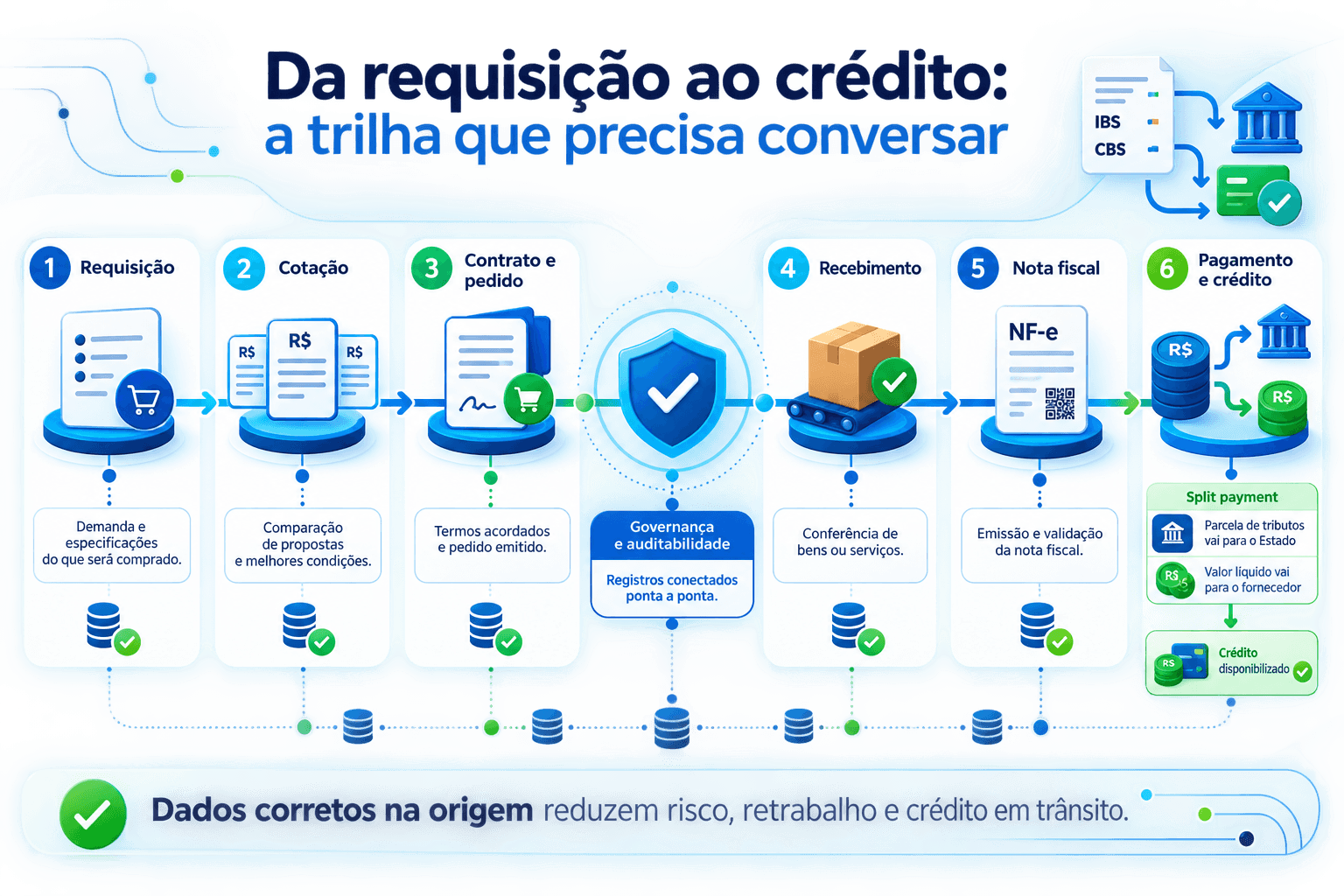
The traditional intersection between order, receipt, and invoice remains important, but it is now integrated into a larger process:
- tax requirement and premise;
- Quotation and supplier selection;
- contract and order;
- receiving or measuring;
- tax document;
- payment and settlement of debt;
- The credit was appropriated and utilized.
This traceability is one of the most important connections between tax reform and spending governance.
How to adapt processes, ERP, and systems to the tax reform?
Updating the ERP system is necessary, but not sufficient. The ERP system typically receives the operational data after relevant decisions have already been made in Purchasing.
If the supplier, establishment, delivery location, category, contract, or payment terms are incorrect at the source, the tax engine may correctly calculate a transaction that was structured incorrectly.
What needs to change in the source-to-pay process?
| Step | Additional information or control |
|---|---|
| Planning and budget | Gross disbursement, projected credit, net cost, and cash flow timing. |
| Request | Establishment, recipient, destination, project, category and purpose. |
| Price | Base price, IBS, CBS, credit, net cost and tax assumptions. |
| Approval | Regime, IBS/CBS option, tax quality, documents and integration. |
| Contract | Transition, price, rebalancing, documentary obligation and split payment |
| Order | Fiscal and commercial data consistent with the quotation and the contract. |
| Receiving or measuring | Physical evidence or service, quantity, location and acceptance. |
| Tax document | Suitability, classification, destination, values, and connection to the operation. |
| Payment | Payment terms, installments, splits, withholdings, chargebacks, and reconciliation. |
| Credit and accounting | Expected, to be appropriated, appropriated, used, and at-risk credit |
How to choose software prepared for tax reform?
Avoid evaluating a solution solely based on its promise of being "suitable for the reform." Verify that it actually achieves this:
- Integrate with the ERP and tax engine;
- Maintain records of suppliers, establishments, items, and services;
- Capture destination and purpose from the request;
- Compare gross price, credit, and net cost;
- to control contracts and regime changes;
- Link order, receipt, document, and payment;
- Handle exceptions, returns, and corrections;
- preserve audit trail;
- To monitor expected, appropriate, and at-risk credits;
- Maintain configurable and updatable rules;
- To operate with multiple companies, branches, works and projects.
A procurement platform does not replace the tax system or accounting expertise. Its role is to govern the data and decisions that feed into these environments.
Where does GOEVO fit into this scenario?
GOEVO operates at the governance layer of the procurement and spending process. The platform can connect:
- structured requests;
- comparative quotes and charts;
- Supplier approval and evaluation;
- contracts and measurements;
- requests and approvals;
- receipts and documents;
- Integrations with ERP and financial systems;
- budget and dashboards;
- audit trail.
Responsible positioning doesn't mean claiming that a purchasing system "solves tax reform." Interpretation and verification continue to depend on specialized areas and solutions. The value lies in bringing accurate data to the start of the process and transforming tax rules into executable and traceable purchasing decisions.
How to prepare the company for tax reform?
Adaptation should be treated as a multidisciplinary program, not as an isolated system upgrade.
1. Create a governance structure for the reform.
Form a team with Purchasing, Tax, Accounting, Finance, Legal, Controlling, and Technology departments. Define responsibilities, decisions, a timeline, risks, and key performance indicators.
2. Segment suppliers, contracts, and categories.
Identify the largest values, categories with the greatest credit potential, suppliers under the Simples Nacional tax regime, labor-intensive services, long-term contracts, CAPEX, imports, and multi-destination transactions.
3. Review master data
Validate CNPJs (Brazilian company tax IDs), establishments, tax regimes, items, services, classifications, delivery locations, projects, cost centers, and payment terms.
4. Simulate the net cost.
Choose real-world purchases and compare the current model with future scenarios. Record the assumptions and don't treat tax rate estimates as a universal rule.
5. Review critical contracts
Prioritize contracts with higher value, long duration, services, technology, construction, recurring payments, and suppliers with the potential to change their terms.
6. Test the entire process.
Execute pilot processes from request to credit. Include returns, cancellations, partial payments, discrepancies, and corrections.
7. Create indicators
Some useful KPIs are:
- Expected versus appropriate credit;
- Credit at risk;
- average appropriation period;
- Tax discrepancies by supplier;
- Document correction time;
- difference between gross price and net cost;
- Revised contracts;
- suppliers with updated regulations;
- purchases made outside of the process.
8. Train the areas
Buyers don't need to replace tax specialists, but they must understand what information changes the decision. Tax and accounting, in turn, need to know when this information arises in the purchasing process.
Purchase Readiness Checklist
Use these questions to assess the current stage:
- Does the price quote map differentiate between gross price, credit, and net cost?
- [ ] Does the registration identify the supplier's tax regime and IBS/CBS option?
- Are the establishment, recipient, and delivery location captured in the request?
- Do critical contracts contain tax transition clauses?
- [ ] Is there a procedure for demonstrating requests for rebalancing?
- Can order, receipt, invoice, and payment be reconciled?
- Does the system track expected, appropriate, and at-risk credit?
- [ ] Do returns and cancellations produce the necessary adjustments?
- [ ] Are Purchasing, Tax, Finance, Legal, and IT departments assigned to specific roles?
- [ ] Were real-world cases of materials, services, SaaS, freight, and CAPEX tested?
- Does the budget differentiate between gross expenditure and net economic cost?
- Are there any fiscal quality indicators for the supplier?
Mistakes that companies should avoid
Treating the reform as an exclusive matter for the Tax Inspectorate
The auditor interprets and validates the rules, but much of the crucial information originates in purchasing, contracts, logistics, and payments.
Apply a single tax rate to all transactions.
Estimates published in the market do not replace an analysis of the specific treatment. Regimes, reductions, destination, nature, and exceptions change the outcome.
Automatically exclude suppliers from the Simples Nacional tax regime.
Credit is one component of the decision, but not the only one. The analysis should consider total cost, quality, lead time, specialization, competition, and supply risk.
To consider credit guaranteed simply because the invoice has arrived.
A valid document is essential, but appropriation also depends on other requirements and the extinction of the debt through legal means.
Accepting generic adjustments due to the reform
Price changes must be demonstrated with assumptions, calculation details, credit effects, and contractual rules.
To believe that the 2026 flexibility postponed the reform.
Suspending certain document rejections reduces immediate operational risk. It does not eliminate the implementation of CBS in 2027 nor the need to prepare processes and systems.
Update only the ERP system.
Tax calculation alone cannot correct an incorrectly structured registration, contract, order, destination, or payment.
Frequently asked questions about tax reform
When does the tax reform begin?
The transition began in 2026, the year of testing for IBS and CBS. CBS enters its definitive phase in 2027. The gradual replacement of ICMS and ISS by IBS occurs between 2029 and 2032. The new model will be fully in effect in 2033.
Which taxes will be replaced?
PIS and Cofins will be replaced by CBS. ICMS and ISS will be replaced by IBS. IPI will be reduced to zero for most products starting in 2027, with exceptions related to the Manaus Free Trade Zone. A Selective Tax was also created.
What are IBS and CBS?
These are the two components of the Brazilian dual VAT system. The CBS is federal. The IBS is a shared responsibility between states, the Federal District, and municipalities. Both apply to a broad range of goods, rights, and services, as per the legislation.
What will the tax rate be under the tax reform?
There is no single tax rate applicable to all transactions. There will be reference rates, rates defined by the entities, reductions, differentiated regimes, specific regimes, zero rates, and exceptions. The company should avoid applying general estimates to specific contracts and purchases without validation.
Does tax reform affect small businesses?
Yes. Companies under the Simples Nacional tax regime will continue to receive preferential treatment, but IBS and CBS taxes will now be integrated into the regime and can be collected within the Simples Nacional or, through an applicable option, under the regular regime. The choice affects cash flow, supply chain credits, and B2B competitiveness.
Do companies under the Simples Nacional tax regime generate tax credits?
The purchaser subject to the regular tax regime may claim credit according to the rules and limits related to the IBS and CBS taxes owed by the supplier under the Simples Nacional regime. If the supplier opts for the regular regime for IBS and CBS, the credit logic changes. Each case must be validated.
How does tax reform affect the service sector?
The effect depends on the cost composition, the use of tax credits, the applicable treatment, the use of labor, and the ability to pass on price increases. For Purchases, it is important to compare gross increase, recoverable credit, and net cost.
Will tax reform increase consumer prices?
The effect will not be the same across all sectors. Credit, competition, pass-through, transition, tax regimes, and productivity all influence the price. The analysis should be done by supply chain and category.
Will every purchase give full credit?
No. There are restrictions, specific treatments, suppliers under the Simples Nacional tax regime, presumed credits, zero tax rate, and documentary and operational requirements. The classification must be defined by the responsible departments.
What is split payment?
It is the separation of IBS and CBS at the time of financial settlement, according to the implementation rules. The mechanism connects payment, debt extinction, and credit security.
What is the impact of tax reform on the area of Procurement?
Purchasing should compare net cost, record tax assumptions, qualify suppliers, review contracts, capture destination and establishment, and integrate purchase order, receipt, document, payment, and credit.
Which software helps with tax reform?
The company will need an integrated ecosystem: ERP, tax engine, electronic documents, finance, and purchasing platform. The solution must preserve data from the requisition stage, apply validated rules, and maintain end-to-end traceability.
Where can I find reliable information about tax reform?
Prioritize Portal for Consumer Tax Reform of the Federal Revenue Service, the Plateau, the IBS Steering Committee and official acts. News and analysis are useful, but they must be compared with current legislation.
Conclusion: tax reform begins before the invoice is issued.
The tax reform doesn't just change the acronyms displayed on the tax document. It changes the question that the company needs to answer before buying.
For a long time, the dominant question was: Which supplier offers the lowest price with the best conditions?
In the new scenario, the question needs to evolve:
Which alternative delivers the lowest net economic cost, with secure credit, correct documentation, an appropriate contract, sustainable financial impact, and complete traceability?
Responding well requires four integrated skills:
- tax and accounting knowledge;
- Knowledge of purchasing processes and supplier management;
- financial and contractual governance;
- Reliable technology and data.
Companies that treat the reform merely as a tax update may fulfill their obligations and still continue making incomplete purchasing decisions. Those that connect Procurement, contracts, suppliers, Tax, Finance, and technology will be better positioned to transform compliance into efficiency, predictability, and governance of expenses.
Do you want to assess how to prepare the purchasing, supplier, contract, and integration processes for the tax reform? Discover GOEVO's Purchasing Management system. And talk to our experts.
For a direct view of the changes by year, also read Tax Reform: What changes in 2026 and 2027.
Official sources and references
Content revised in September 1, 2026. As standards, regulations, and layouts continue to evolve, sources should be re-checked before future updates.
- Constitutional Amendment No. 132/2023 — Planalto
- Complementary Law No. 214/2025 — IBS, CBS and Selective Tax
- Complementary Law No. 227/2026 — Management Committee and regulation of the IBS
- Decree No. 12,955/2026 — CBS Regulations
- Regulations of the IBS Management Committee
- Brazilian Federal Revenue Service — Understanding the Consumer Tax Reform
- Brazilian Federal Revenue Service — Guidelines for 2026
- Schedule for electronic tax documents
- Easier IBS and CBS validation procedures on tax documents.
- CBS Platform Manual — Federal Revenue Service
- Simple National Tax Regime Options for 2027 — Federal Revenue Service, September 1, 2026
Statement of responsibility
This article is for informational, strategic, and educational purposes only. It does not replace legal, tax, accounting, or fiscal advice applied to the specific operations of a company. Before changing prices, contracts, registrations, credit appropriations, or payments, validate the situation with qualified professionals and with the legislation in force on the date of the transaction.