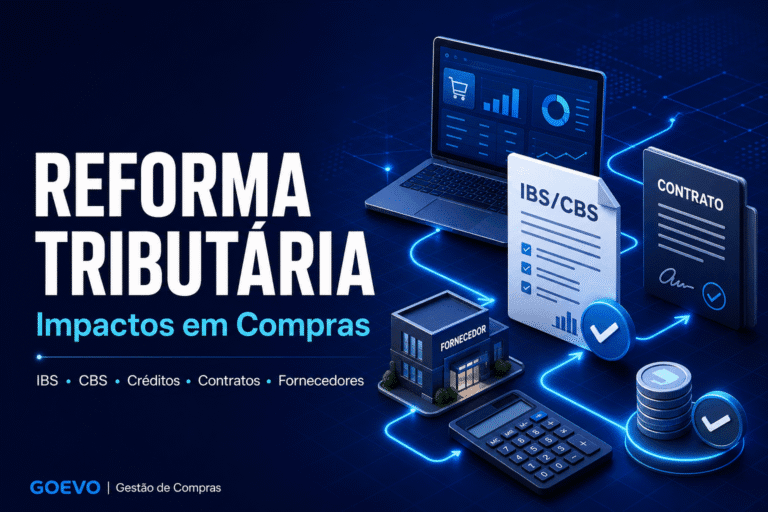




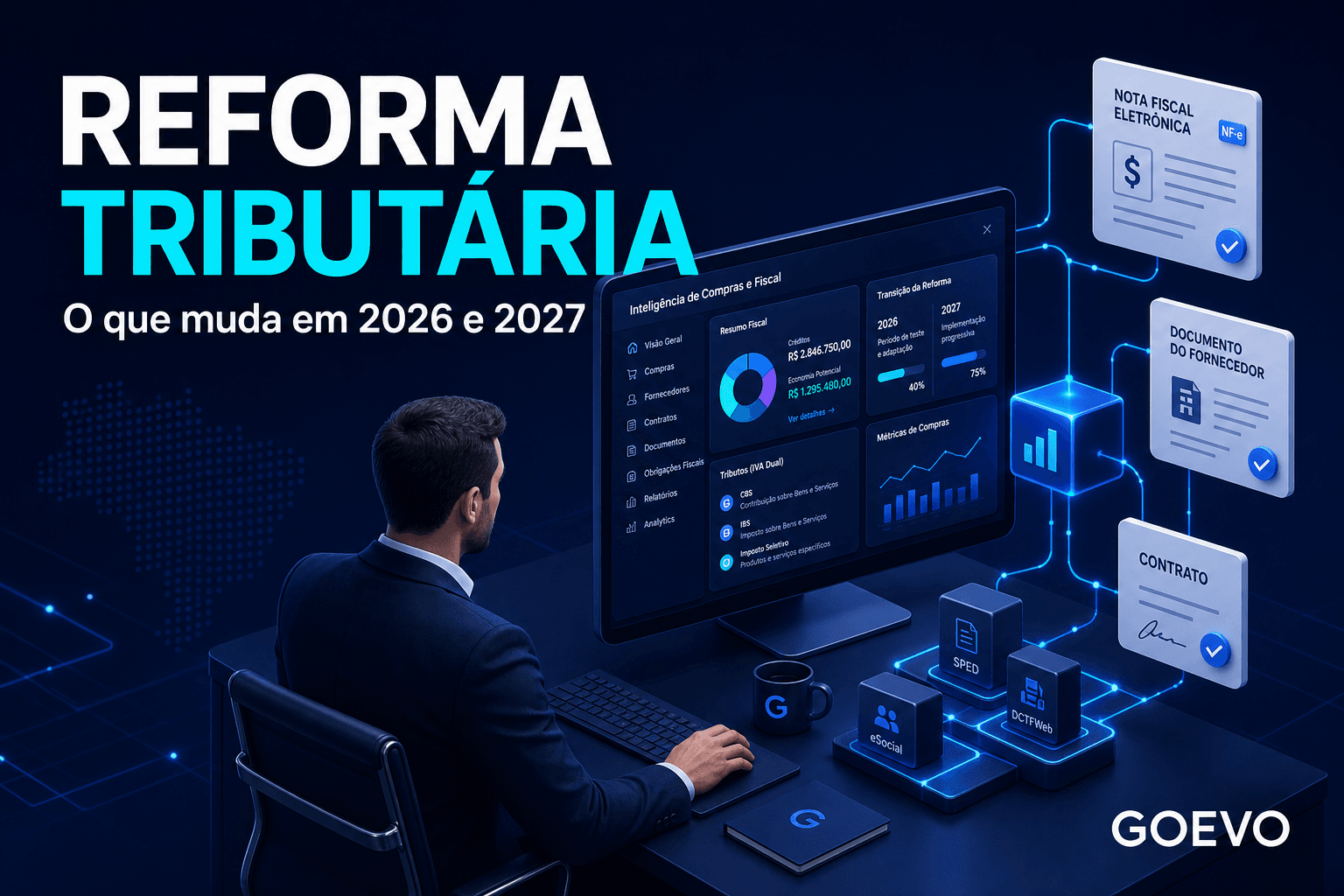
In summary: 2026 is the year of operational testing and adaptation; 2027 marks the entry into force of CBS (Contribution on Goods and Services) collection and the extinction of PIS and Cofins (Social Integration Program and Social Security Financing Contribution). For companies, the change is not limited to tax matters: it extends to invoices, supplier registration, contracts, and the way purchases are compared.
Content updated on September 2, 2026, for informational and educational purposes. The application of the rules to a specific transaction must be validated by the tax, accounting, and legal departments and by qualified professionals.
Author and update: editorial content of GOEVO, Revised on September 3, 2026. This material explains operational impacts for companies; tax decisions should be validated by qualified professionals and the official sources indicated throughout the text.
The consumption tax reform reorganizes the taxation of goods and services in Brazil, in accordance with... Complementary Law No. 214/2025. In the new model, the federal Contribution on Goods and Services (CBS) and the Goods and Services Tax (IBS), levied by states and municipalities, gradually replace current taxes. There is also the Selective Tax (IS), applied to goods and services that are harmful to health or the environment, according to legal regulations.
The key point for anyone managing a company isn't memorizing acronyms. It's understanding that decisions to buy, sell, issue invoices, hire, and pay will require better fiscal data. A poorly issued invoice, a supplier without correct information, or a vague contractual clause can compromise credit, deadlines, costs, and predictability.
For an in-depth look at Procurement, also read GOEVO's guide on... Impacts of tax reform on purchases, contracts, and suppliers..
What will change with the tax reform in 2026?
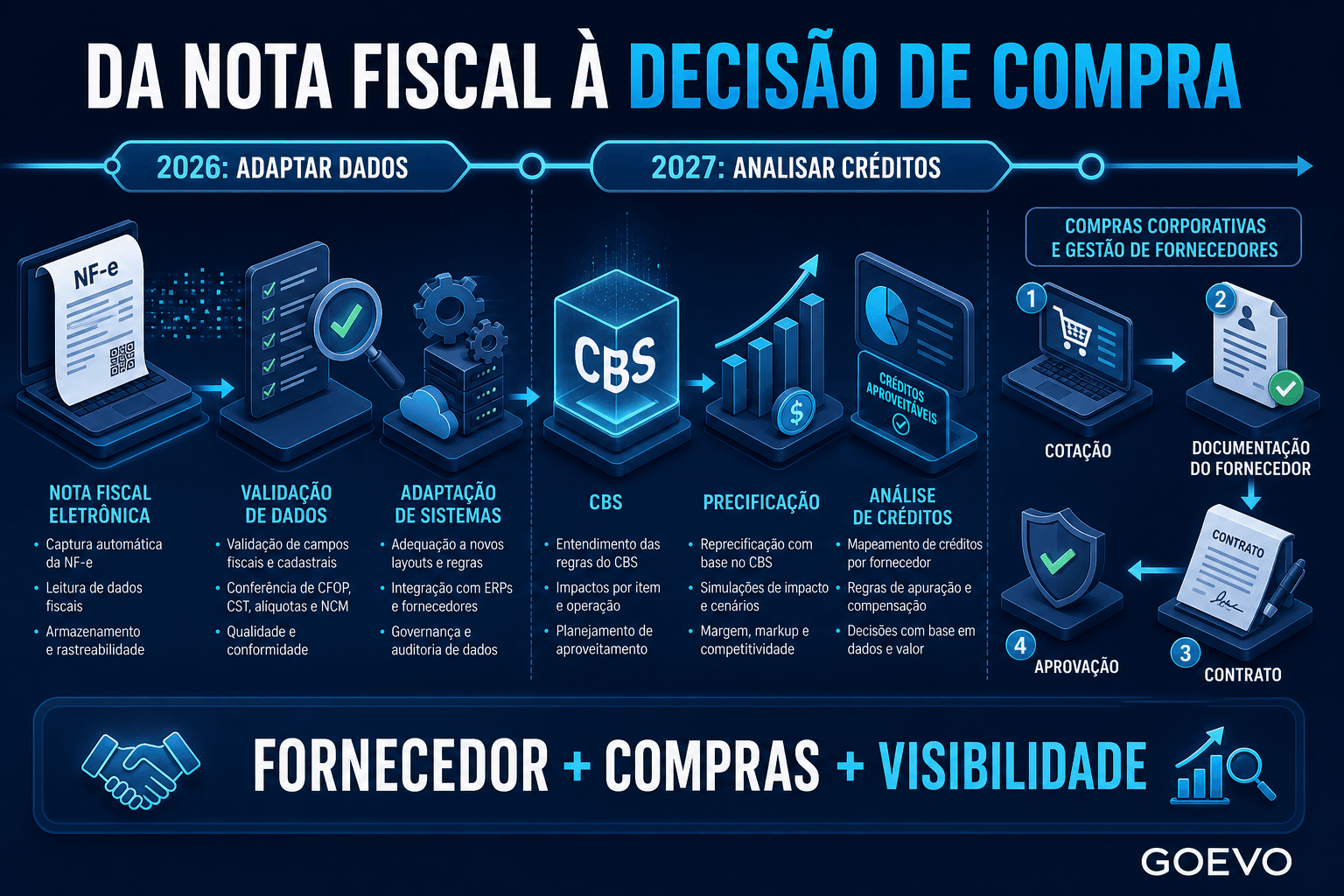
2026 is the test year for CBS and IBS. In practice, companies need to adapt electronic tax documents, registrations, business rules, and integrations to report the new taxes when applicable. Once the required ancillary obligations are fulfilled, there is an exemption from collecting CBS and IBS during the testing period, according to the... Federal Revenue Service guidelines for 2026.
A Brazilian Federal Revenue Service advises That, as of January 1, 2026, documents such as NF-e, NFC-e, CT-e, and CT-e OS must evolve to allow for the individualized highlighting of CBS and IBS, according to the applicable layouts and technical notes. This is not just a layout adjustment: it is the beginning of a new requirement for data quality in operations.
Simple example
Imagine a company that purchases maintenance services for multiple branches. Before 2026, it could treat the quotation process as a comparison between price, deadline, and supplier. Now, it needs to ensure that the requisition, order, and invoice contain sufficient data to identify the operation, tax treatment, and necessary documentation. If information gets lost between Purchasing, supplier, and Tax, rework appears at the end of the process—when it costs more to correct.
What will change with the tax reform in 2027?
In 2027, CBS will move to the collection phase, and PIS/Cofins will be phased out. The implementation of the Selective Tax and the reduction of the IPI (Tax on Industrialized Products) to zero for most products are also planned, while preserving the specific rules of the Manaus Free Trade Zone.
The IBS (Brazilian VAT) has a longer transition period: the replacement of ICMS (State VAT) and ISS (Municipal Service Tax) is gradual, starting in 2029 and with the full model planned for 2033. This means that 2027 is not the end of the adaptation. It is the moment when the change ceases to be predominantly preparatory and begins to more directly affect calculation, documentation, credit, and price.
| Period | Main change | Management question |
|---|---|---|
| 2026 | CBS and IBS testing; document and system evolution | Is the process data ready? |
| 2027 | CBS in collection; end of PIS/Cofins; start of IS | How do the new costs and credits affect price and margin? |
| 2029–2032 | Gradual transition from ICMS/ISS to IBS | How to maintain consistent rules, contracts, and suppliers? |
| 2033 | New model fully in effect. | Is the operation prepared to make decisions based on net cost? |
What changes in the way invoices are issued?
The invoice becomes even more relevant as a source of information for taxes, credit, and verification. Electronic documents are receiving specific fields and groups for IBS and CBS. In services, for example, the evolutions of the NFS-e include adaptations for operations and adjustments of credit and debit.
For the purchasing company, this raises a practical question: does the document received from the supplier allow verification of what was ordered, delivered, contracted, and handled fiscally? For the selling company, the question changes: can the registration, the ERP, and the invoicing process generate the correct document without requiring manual corrections?
This is not a discussion isolated to the tax area. The data originates in the demand, goes through the quotation and the contract, is formalized in the order, and needs to match the receipt, invoice, and payment. The more fragmented the process, the greater the risk of incomplete or divergent information.
What changes for companies under the Simples Nacional tax regime?
The Simples Nacional tax regime remains in place. However, companies need to understand how the choice of collecting IBS and CBS taxes can affect their own tax credits and their ability to transfer credits to customers.
In simple terms, a supplier under the Simples Nacional tax regime can collect IBS and CBS within the regime or, according to the option rules, under the regular regime for these taxes, maintaining Simples Nacional for the others. This choice should not be treated as an operational detail: it can influence the interests of larger clients who need to evaluate the credit and economic cost of each purchase.
For 2027, the The Federal Revenue Service reported The option window in September 2026 for companies interested in the Simples Nacional tax regime and for defining the method of collecting IBS/CBS taxes will open. This decision needs to be made with accounting and tax guidance, as it varies depending on the business and the supply chain in which the company operates.
What does this mean for a larger company that buys from smaller suppliers?
This doesn't mean that small businesses will cease to be good suppliers. It means that the buyer will have more variables to analyze, and the smaller supplier will need to be more transparent about its tax and documentation status.
Previously, a bid could only win based on the lowest price. In the new scenario, the purchasing company tends to evaluate:
- gross price and total purchase price;
- Credit that is effectively recoverable and the timeframe for utilizing it;
- Supplier's tax regime and documentation status;
- Alignment between quotation, order, contract and invoice;
- risk of discrepancy, rejection, correction or delay;
- Cash flow impact and continuity of supply.
The best supplier may still be the smallest or most local. But the decision needs to be explainable, documented, and comparable—not based solely on the price displayed on the first line of the proposal.
What changes for services, contracts, and suppliers?
Service contracts need to review pricing, tax clauses, adjustments, and responsibility for documentation. In the services sector, the change can be especially sensitive because current practices often involve municipal regulations, service taxes, withholdings, lengthy contracts, and scopes that are difficult to compare. The reform does not eliminate the need for good contract management; it increases the value of clear clauses regarding price, taxes, adjustments, documentation, liability, and handling of changes.
In supplier management, registration and approval cease to be bureaucratic tasks. They become part of risk control and decision quality. The company needs to know who the supplier is, what their tax regime is, what documents are valid, what commercial conditions were negotiated, and what path led to the purchase.
It's worth reviewing the process of supplier approval and connect your criteria to the Purchasing routine, instead of keeping them in separate spreadsheets.
What changes in practice for the Purchasing area?
Purchasing now operates with a more comprehensive understanding of value. Lower price does not necessarily mean lower cost. A proposal may be cheaper and still result in lower credit recoverability, higher documentary risk, a shorter deadline, higher financial costs, or the need for rework.
Practical example: two proposals, one better decision.
A company receives two quotes for a recurring service:
- Supplier A: The price of R$ is 100,000, but the tax data is incomplete, the correction deadline is uncertain, and the documentation is nearing its expiration date.
- Supplier B: Price of R$ 104 thousand, valid documentation, known tax status, shorter delivery time and already structured contract.
The buyer should not automatically conclude that option B is better. They must organize the data so that the tax, finance, and management teams can assess the net economic cost and risk. This is the difference between buying based on price and buying with governance.
Checklist: What should companies prepare now?
- Mapping documents and integrationsWhich systems generate, receive, and verify NF-e, NFS-e, CT-e, orders, and contracts?
- Review supplier records.Are the company's tax regime, CNPJ (Brazilian tax ID), documents, bank details, categories, branches, and responsible parties up to date?
- Standardize the requestDoes the request specify the item, service, location, deadline, cost center, scope, and required attachments?
- Review active contractsAre the price, adjustments, responsibilities, documentation, and transition rules clear?
- Create a shared vision.Purchasing, Tax, Accounting, Finance, Legal, and IT need to agree on responsibilities, data, and exceptions.
- Training suppliers and requestersThe seller needs to know what information the customer will require; the person requesting the information needs to understand why a properly completed field prevents delays and risks.
Do you need to structure purchases, suppliers, contracts, and approvals for the transition? Discover the GOEVO SCM And see how to centralize data, workflows, and traceability throughout the process.
Tax reform raises awareness among both buyers and sellers.
The reform changes the conversation on both sides of the table.
Who sells You need to understand that price, delivery time, and product quality are not enough. Regime, documentation, ability to issue invoices correctly, and transparency about the operation become key factors in attracting larger clients.
Who buys We need to abandon the view that economics lies solely in negotiating the lowest price. Credit, document compliance, supplier risk, deadlines, and cash flow all factor into the economic cost of the decision.
That's why integrated supplier management with Purchasing will become increasingly essential. GOEVO is preparing its systems to help clients connect requisition, quotation, approval, supplier, contract, order, document, and payment—with greater security, traceability, and visibility to make better decisions. The platform does not replace fiscal, accounting, or legal validation; it organizes the process and data so that these decisions happen at the right time.
Frequently Asked Questions about Tax Reform
What will change with the tax reform in 2026?
2026 is the test year for CBS and IBS. Companies need to adapt electronic tax documents, processes, and systems to the ancillary obligations and the new applicable fields.
What will change with the tax reform in 2027?
In 2027, the CBS (Contribution on Goods and Services) will come into effect and PIS/Cofins (Social Integration Program/Contribution to Social Security Financing) will be phased out. Changes to IPI (Tax on Industrialized Products) and Selective Tax will also be implemented. The transition from ICMS (Tax on Circulation of Goods and Services) and ISS (Tax on Services) to IBS (Integrated Tax System) will continue gradually until 2033.
What changes in the way invoices are issued?
Electronic tax documents are undergoing adjustments to record IBS and CBS information. Therefore, data quality, system integration, and document verification become even more important.
What changes for companies under the Simples Nacional tax regime?
The Simples Nacional tax regime continues, but the method of calculating and collecting IBS/CBS taxes may influence credits and B2B relationships. The decision should be evaluated with accounting and tax support.
What changes for companies that buy from smaller suppliers?
In addition to price and delivery time, it will be important to evaluate the supplier's terms, credit, documentation, billing capacity, and operational risk. The goal is not to exclude small suppliers, but to compare them within a broader context.
Official references
- Guidelines from the Federal Revenue Service for 2026
- Understanding the Consumer Tax Reform — Federal Revenue Service
- Schedule for electronic tax documents — Ministry of Finance
- Adaptation of the Simples Nacional (Simplified National Tax Regime) — Ministry of Finance
- Complementary Law No. 214/2025, updated