
Artificial intelligence in invoices: how to automate the reading, checking, and validation of documents.
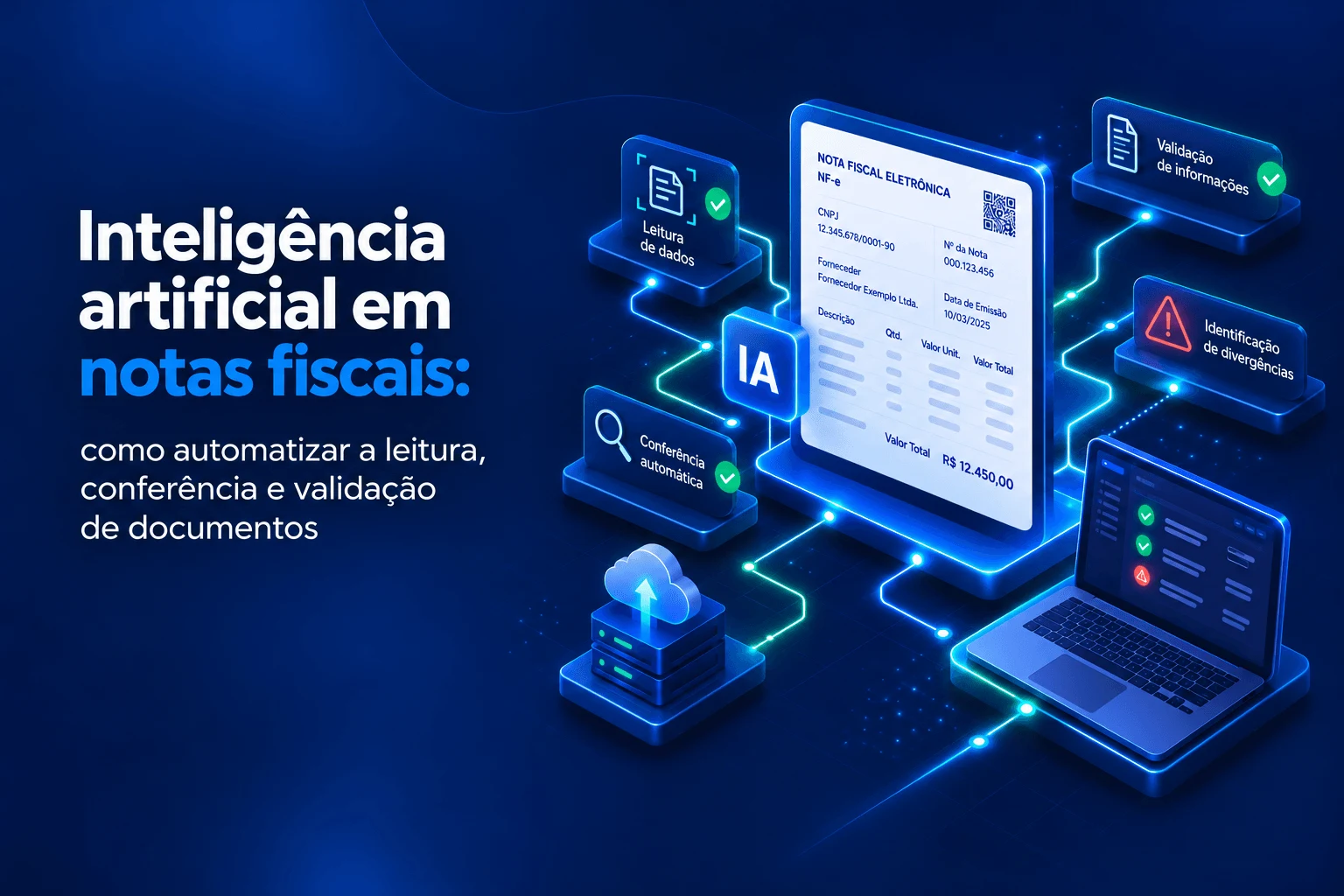
A Artificial intelligence in invoices It can help companies extract data from documents, identify discrepancies, and accelerate the reconciliation between invoices, purchase orders, and receipts. Combined with business rules and integrations, the technology reduces repetitive tasks and directs the team to the cases that truly need analysis.
The opportunity goes beyond simply digitizing documents. An invoice gathers information that needs to be consistent with the supplier's registration, the negotiated conditions, the order, the contract, the delivery, and the applicable tax rules. When this data doesn't match, the discrepancy translates into rework for Purchasing, Tax, Finance, and other departments.
In this guide, you will understand how AI-powered invoice automation works, what the technology's limitations are, how to organize a reliable verification workflow, and what to evaluate before implementing a solution.
What is artificial intelligence applied to invoices?
It is the use of AI models and techniques to Interpret tax documents and support tasks such as classification, information extraction, identification of inconsistencies, and handling of exceptions.. In a business process, AI can work alongside XML readers, optical character recognition (OCR), deterministic rules, and integration with management systems.
In structured electronic tax documents, such as the NF-e (Brazilian electronic invoice), much data is already available in XML format. In these cases, extracting the XML correctly is usually more reliable than trying to recognize the same fields in an image. AI adds value mainly when it is necessary to interpret attachments, descriptions, unstructured documents, or situations that cannot be resolved using only fixed rules.
The goal should not be to delegate all responsibility to technology. Tax validation and financial approval require defined criteria, an audit trail, and proper handling of exceptions.
What data can be included in the conference?
Depending on the document type, process, and available integrations, the analysis may involve the issuer's CNPJ (Brazilian tax ID) and identification, number and series, dates, items, quantities, units, prices, discounts, shipping, taxes, totals, and order reference. The relevance of each field changes according to the operation.
What is a discrepancy in an invoice?
A discrepancy is an inconsistency between the document and expected information or a rule. Examples include: invoiced quantity different from received, unit price different from agreed upon, supplier incompatible with the order, or absence of a necessary reference. Not every discrepancy indicates a tax error: some result from partial receipts, authorized tolerances, or specific contractual conditions.
Why does manually checking invoices lead to rework?
When purchase information circulates between emails, spreadsheets, PDFs, and systems that don't communicate with each other, the team needs to reconstruct the context of each invoice. The professional searches for the order, checks the supplier, compares the values, verifies the receipt, and requests corrections whenever something doesn't match.
This work is necessary, but some of it can be standardized. The problem is exacerbated in companies with many units, a large volume of items, or different people responsible for requesting, purchasing, receiving, and paying.
The most frequent consequences are delays in document release, difficulty in identifying the source of the discrepancy, repeated checks, and poor visibility of recurring errors. Automation is valuable when it eliminates redundant steps. without eliminating the necessary control.
How does AI-powered invoice automation work?
A well-designed process separates data capture, verification, decision and recording. The specific architecture depends on the ERP system, internal rules, and the type of tax document.
1. Receipt and identification of the document
The company receives the document through authorized channels, such as integration, portal, or controlled entry process. The first step is to identify the document type and locate the reference data necessary for verification.
2. Extraction and standardization of information
The system reads the available structured data and, when necessary, uses OCR and AI to interpret information in less standardized formats. The extracted fields must be normalized and associated with the source document, preventing interpreted data from being automatically treated as true.
3. Comparison with order, contract and receipt
The information is verified against what the company actually negotiated and received. The comparison may consider quantity, price, unit, supplier, payment terms, and previously defined tolerances.
4. Identification and classification of exceptions
Significant discrepancies are flagged to the appropriate person. A quantity discrepancy, for example, may require involvement from the receiving department; a contractual discrepancy may be returned to Purchasing or the contract manager.
5. Validation and forwarding
The workflow applies business rules and handles situations that depend on professional judgment. The role of AI is... support the conference, This does not replace the tax, legal, or accounting validation required for the transaction.
6. History, evidence and continuous improvement
The record of the occurrence, analysis, and decision allows for the identification of patterns: suppliers with a higher incidence of discrepancies, items prone to error, and stages where rework is concentrated.
OCR, automation rules, and AI: what's the difference?
These technologies complement each other, but they don't do the same thing.
| Technology | Main role | Example of use |
|---|---|---|
| Reading XML | Capture already structured data from the NF-e (Brazilian electronic invoice). | Retrieve issuer, items, and values directly from the tax file. |
| OCR | Convert text present in images into readable data. | Read information from a scanned PDF. |
| Rule-based automation | To verify predefined objective conditions. | Alert when the value exceeds the allowed tolerance. |
| Artificial intelligence | Interpreting, classifying, and identifying patterns in varied data. | Match similar descriptions and prioritize exceptions for review. |
The right choice depends on the need. Using AI to perform a simple comparison that can already be solved deterministically doesn't always bring benefits. The best design usually brings together different technologies in a transparent and auditable way.
What benefits can be gained from automating invoicing?
Less typing and repetitive checking.
Structured data capture reduces the need to manually transcribe information. The real gain should be measured in operation, also considering the work required to correct incorrect results.
Faster identification of discrepancies
Instead of discovering problems when payment is imminent, the company can identify discrepancies as soon as the document is received, when there is still time to contact the appropriate person.
More traceability between areas.
When order, receipt, and invoice records are connected, it becomes easier to understand which information triggered the analysis and who authorized an exception.
Better use of the team
Professionals can dedicate more time to negotiation, supplier relations, risk assessment, and resolving high-impact incidents.
Data to improve the process.
Monitoring discrepancies allows for the review of item descriptions, receiving criteria, registrations, and operational rules. This is how automation can fuel continuous improvement, not just accelerate the current task.
Practical example: an invoice that differs from the order.
Imagine that a company has approved the purchase of 100 units at R$ 80 each, totaling R$ 8.000 in items, without considering other price components. Upon delivery, the verification only records... 90 units received, while the invoice shows the 100 units originally ordered.
An integrated workflow can compare order, invoice, and receipt, highlighting any discrepancy of 10 units for analysis. The team verifies if there was a partial delivery, goods in transit, a receiving error, or a need for document correction.
Technology should not assume which of these situations occurred. Its value lies in Present the divergence with context and evidence., reducing the time that would be spent gathering scattered information.
What risks and precautions does the company need to consider?
Data quality and security
Incorrect order, registration, or receipt data leads to unreliable reconciliations. Tax documents also contain sensitive business information, requiring access controls, appropriate storage, and privacy and security assessments.
Misinterpretations of AI
Models can misinterpret fields, omit information, or generate unfounded conclusions. Therefore, the source data must remain verifiable, and critical rules need control mechanisms.
Tax rules and liabilities
Document automation does not replace tax obligations or the work of the responsible teams. The handling of taxes, documents, and credits must comply with applicable legislation and be validated by qualified professionals.
Integration and exception handling
An isolated automation can create an additional manual step if there is no connection to existing systems and responsibilities. Before deploying, define which exceptions will be blocked, reviewed, or escalated for correction.
How to evaluate an AI solution for invoicing?
Before hiring or developing an automation solution, it's worth answering the following questions:
- What types of documents will be processed, and which ones have structured data available?
- Where will the information for comparison come from: ERP, order, contract, and receipt?
- Which rules are deterministic and which ones actually need AI?
- How does the solution show the source of each interpreted data point?
- What happens when there is low trust, failure, or disagreement?
- How do access controls and decision logging work?
- What indicators will allow us to measure the results after implementation?
Useful metrics include average conference time, percentage of documents with discrepancies, types of errors, rework by area, and resolution time. The indicator should be measured before and after implementation to avoid conclusions without evidence.
What is the relationship between artificial intelligence in invoicing and purchasing management?
The invoice is not an isolated step. It depends on information produced throughout the entire process: purchase need, quotation, approval, order, contract, and receipt. The more structured this process is, the more reliable the document comparison tends to be.
Therefore, the discussion of AI in invoices connects to purchasing management. A company that records decisions, organizes responsibilities, and preserves transaction history creates better conditions for automating checks and identifying problems at their source.
To understand the broader role of technology in the department, see also the article. AI in Procurement: How to Gain Efficiency Without Reducing the Team's Strategic Capacity.
Artificial intelligence in invoices and tax reform: what to watch out for?
The changes brought about by the consumption tax reform reinforce the importance of the quality of fiscal data and the integration between areas. Documents, records, and systems need to comply with the layouts and rules applicable to operations.
That it doesn't mean Using AI to ensure tax compliance is a challenge. Technology can support the organization and screening of information, but regulatory interpretation and tax compliance require specific rules and specialized validation.
GOEVO already addresses the changes for companies and purchasing departments in its content. Tax Reform: What changes in 2026 and 2027.
How does GOEVO contribute to a more connected purchasing management system?
A GOEVO It is a platform focused on purchasing management and expense governance. Its focus is to connect processes such as requests, quotes, proposal comparisons, approvals, and orders, with traceability and integration to business systems according to the contracted project.
This governance structure is relevant to any document automation initiative: The better the source data and processes, the better the conditions for verifying information and addressing discrepancies..
GOEVO also monitors and develops initiatives related to artificial intelligence and document processing within the purchasing operation. Specific AI-powered tax reading and validation capabilities must be confirmed with the sales team before being considered available for production.
Discover the GOEVO's purchasing management platform and assess how to structure a more connected operation.
Frequently asked questions about AI in invoices
Can artificial intelligence read electronic invoices?
Yes, AI can support the processing and interpretation of tax information. However, when the document has structured XML, directly reading this data is usually the first option; AI and OCR are complementary tools for specific needs.
Can invoice reconciliation be fully automated?
Certain checks can be automated based on clear rules, data quality, and available integration. Discrepancies, exceptions, and relevant tax decisions may require human review.
Is AI replacing OCR?
Not necessarily. OCR extracts text from images, while AI can interpret and classify information. The technologies can work together, depending on the document format.
How to automatically compare invoices and purchase orders?
It is necessary to link the document data to the order records and apply rules to verify, for example, supplier, items, quantities, prices, and tolerances. Receiving and contract information may also be required.
Can medium-sized companies use automated invoicing?
Yes. The benefit depends more on the repetition of tasks, the types of documents, the integration, and the volume of exceptions than solely on the size of the organization.
Does AI in invoicing ensure compliance with tax reform?
No. It can help organize information and identify inconsistencies, but compliance requires up-to-date tax rules, adequate systems, and validation from responsible professionals.
Conclusion: automating conferences requires technology and governance.
Artificial intelligence in invoicing can reduce repetitive tasks, accelerate the identification of discrepancies, and support more informed decisions. However, the result depends on reliable data, system integration, defined processes, and supervision of exceptions.
The most important change is to stop treating the invoice as a disconnected document. When Purchasing, Receiving, Contracts, Finance, and Tax work with consistent information, it becomes easier to combine automation, control, and efficiency.
Do you want to improve the traceability and governance of your purchasing process? Talk to the experts at GOEVO. and understand how to structure an integrated operation, with greater visibility into expenses.
Author: Welington Humberto He is the CEO of GOEVO, a technology company specializing in procurement management and expense governance. He shares perspectives on innovation, business management, and the evolution of procurement processes.
LinkedIn: Welington Humberto