



Many medium-sized companies still manage purchases using spreadsheets. The problem isn't Excel itself; it's what it hides. Unauthorized expenses, suppliers without a track record, email approvals, and purchase cycles that drag on for weeks. As the operation grows, this model begins to fail, and the signs appear quickly: duplicate orders, rework in reconciliation, and loss of control over spending. Understanding how to choose a corporate purchasing system for a medium-sized company starts with recognizing exactly these breaking points.
The decision to adopt a purchasing management system solves these problems, but the wrong decision creates others. Never-ending implementations, systems that don't communicate with the existing ERP, teams reverting to spreadsheets due to lack of usability. Each of these scenarios has a high cost, and none of them need to happen.
This guide covers the criteria that truly matter: essential functionalities, ERP integration, true total cost, selection process, and indicators to measure return on investment. The content reflects accumulated experience in monitoring selection processes, including what Goevo's clients have encountered along the way.
Features that truly matter in a corporate purchasing platform.
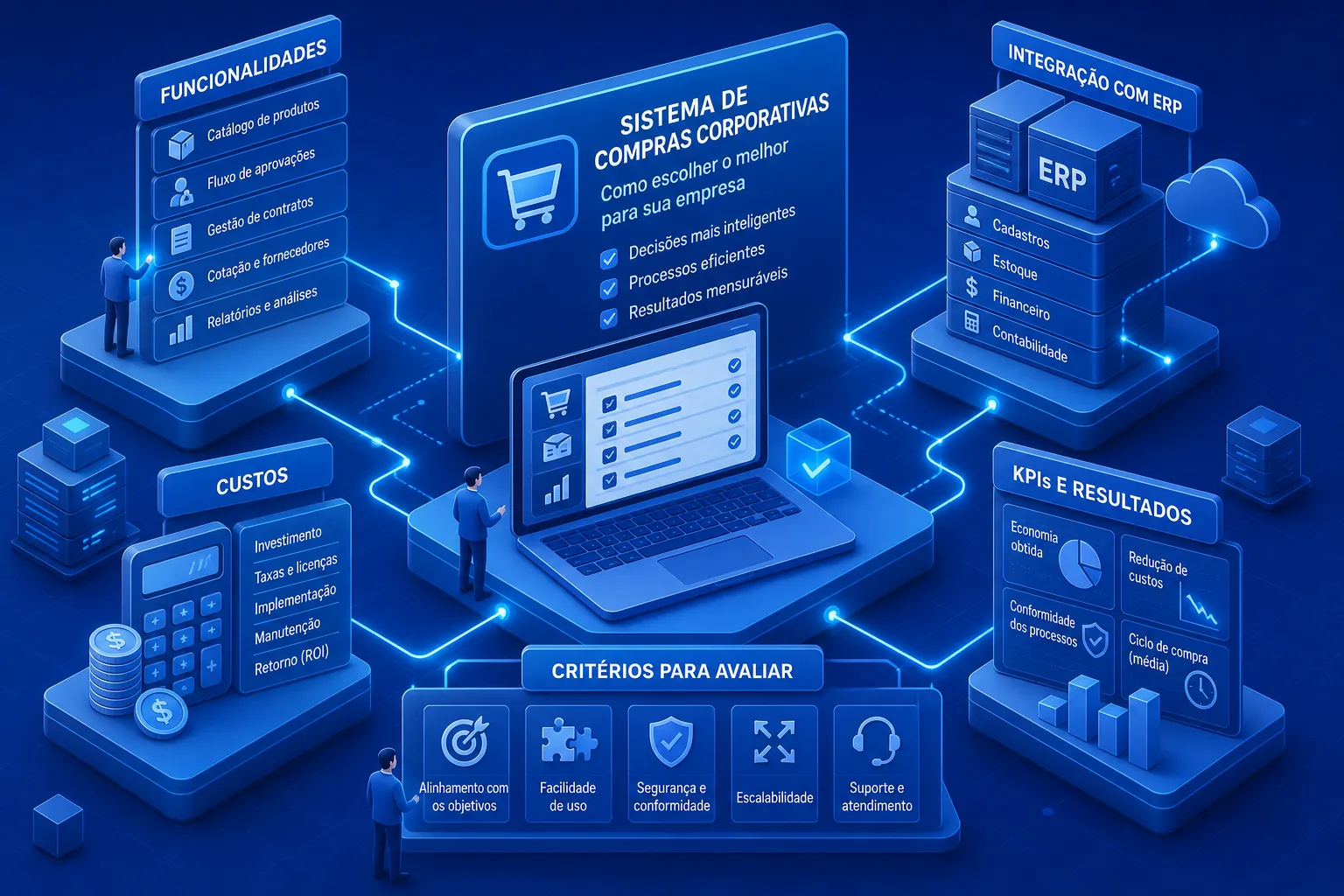
Before evaluating any supplier, it's necessary to understand what the system needs to do. A corporate purchasing platform must cover the entire cycle: internal requisition, structured quotation, approval by authority level, purchase order generation, receipt, invoicing, and expense analysis. Any gap in this cycle forces parallel processes, i.e., spreadsheets back into use.
For medium-sized companies in 2026, the essential functionalities are:
- Management of requests with approval workflow by authority level and audit trail.
- Supplier portal with document approval and control.
- Structured comparison of quotes using standardized criteria.
- Contract management with automatic expiration alerts.
- Real-time expense reports by cost center
Features such as artificial intelligence for demand classification, native mobile access, and advanced purchasing strategies are desirable, but should not block the initial decision. In practice, there is a tendency to discard systems due to a lack of resources that the operation is unlikely to require in the first two years, and this delays the resolution of more urgent problems.
Supplier management deserves special attention in this assessment. It is often underestimated, but it directly impacts compliance and the quality of the purchasing cycle. Buying from a supplier with expired documentation or without a performance evaluation is a risk that a well-configured system significantly and automatically reduces. Systems that centralize registration, documentation, performance history, and approval processes are structurally more secure than those that treat the supplier as merely a text field.
ERP integration: where implementations most often fail.
Integration with the ERP system is often the most expensive point of failure in an implementation. A purchasing system that doesn't communicate with the existing ERP creates rework, fragments data, and generates excessive dependence on the IT team to reconcile information between systems.
Each ERP system has its preferred integration mechanism. TOTVS operates via WebServices, EAI/ESB, APIs, and native iPaaS, with specific version prerequisites and parameterization of the purchasing, inventory, and billing modules. SAP uses OData, IDocs, BAPIs, and middleware tools such as SAP Integration Suite. Oracle supports REST APIs and loads via FBDI for batch operations.
Given this, the manager needs to ask the supplier which of these mechanisms are natively supported and whether there is a ready-made connector or if the integration requires custom development. Custom development means hidden maintenance costs that accumulate with each ERP update, and this cost rarely appears in the initial proposal.
There are specific questions that separate good suppliers from empty sales promises: What is the minimum supported ERP version? Is the synchronization of supplier, cost center, and item records automatic or manual? How are integration failures handled? Is there an audit log with reprocessing? Does the supplier have documented cases of integration with your company's specific ERP? These questions filter out systems that work well in demonstrations but fail in real-world operation.
How to choose a corporate purchasing system for a medium-sized company: usability, support, and real cost.
A powerful system that nobody uses is more expensive than a spreadsheet. For medium-sized companies, purchasing teams are often lean and don't have time for long learning periods. The interface needs to be intuitive for buyers, requesters, and approvers who access the system sporadically. Test with real users before subscribing, not just the sales-led demo. The everyday user experience is usually quite different from what you see in a guided presentation.
The real cost goes far beyond the monthly license. For medium-sized companies in Brazil, the monthly license is around R$ 300 to R$ 1,000. Deployment costs vary from R$ 1,000 to R$ 20,000, and can increase when there are complex integrations and customizations. Ongoing maintenance and support complete the picture. In practice, the license represents only R$30% to R$50% of the total cost in the first three years. Ask the vendor for a total cost of ownership projection for 12, 24, and 36 months. Vendors who cannot clearly present this number rarely deliver the deployment within the planned budget.
How to compile your list of candidates and compare them using criteria.
With the criteria defined, the selection process needs to be objective. A multi-criteria evaluation works well: high weight for essential functionalities and integration with the current ERP, medium weight for total cost of ownership and local support, and lower weight for the product evolution plan. This model prevents a system from winning the evaluation simply because it has a more polished demonstration.
Global platforms While SAP Ariba and Coupa may be robust, they are often scaled beyond what medium-sized companies need, both in terms of cost and deployment complexity. Solutions developed for the Brazilian market tend to have less friction in adapting to the local tax context because they don't require extra layers to handle electronic invoicing (NF-e), average cost, and integration with national ERPs.
Demand a pilot project using real data from your company, not data prepared by the vendor. The pilot should test the complete workflow: creating a requisition, obtaining quotes from three vendors, obtaining approvals through various levels of authority, generating the order, and verifying that the integration with the ERP system works without manual intervention. Problems discovered during the pilot phase cost time. Problems discovered after the contract is signed cost money. This distinction is worth emphasizing for any stakeholder who wants to skip this step.
KPIs to prove that the implementation was worth the investment.
Without defined indicators before deployment, it's impossible to know if the system worked. The baseline needs to be established before the system goes live, not after. Most relevant KPIs For medium-sized companies, the following are objectives and measurable:
- Economics on managed spending: The market benchmark is 5% to 8% of volume under management.
- Purchase cycle timeframe: The time between the request and the approved order, which in manual processes usually ranges from two to four weeks, drops to two to seven days with automation.
- Percentage of spending under contract: The benchmark target is 85% or higher.
- Expenditure outside the approved process: A well-configured system directly reduces this deviation by blocking orders without a budget or from unapproved suppliers.
- Buyer productivity: The benchmark is 120 to 180 orders per buyer per month.
Before signing any contract, define goals on two complementary levels. On the financial level: reduction in acquisition costs, documented savings, and cost per order processed. On the operational level: percentage of purchases that go through the system versus purchases made outside the flow. A system with 60% adoption tends to deliver an equivalent fraction of the promised value, and this correlation should be clear to all involved. The adoption goal should be included in the implementation contract, with shared responsibility between the company and the supplier. Suppliers who refuse this clause are saying something important about their confidence in their own product.
A platform built for the Brazilian reality.
International platforms were built for fiscal, contractual, and operational realities different from Brazil's. Adaptations for electronic invoicing, average cost calculation according to national legislation, integration with TOTVS SAP and LGPD compliance are not optional customizations; they are operational requirements. Platforms that are not designed to meet these requirements need layers of adaptation that increase cost, time, and risk.
Goevo was developed for medium and large Brazilian companies that need a single environment for managing purchases, contracts, suppliers, inventory, and budget. The modules cover the complete cycle: approval workflow with control of authorized expenses, contract management with automatic expiration alerts, supplier approval and integration, integrated budget with blocking of orders without approved availability, exportable indicators and dashboards, and integration with the main ERPs in the Brazilian market. The goal is not to replace the existing ERP, but to deepen the purchasing cycle where the ERP lacks sufficient depth.
The decision begins with the criteria, not the suppliers.
Choosing a corporate purchasing system for a medium-sized company is not an IT decision. It's a business decision with a direct impact on cost, compliance, and operational efficiency. The starting point is the functionalities, distinguishing what is essential from what is desirable. From there, the evaluation progresses through technical integration with the ERP, the real total cost, and local support, until reaching a structured selection with a real-world pilot and indicators defined before signing the contract.
This approach works because it separates what looks good in a demonstration from what sustains day-to-day operations. Any system that doesn't survive this evaluation process will cost more than it appears in the initial budget.
If your company is currently in this process and wants to know in practice how to choose a corporate purchasing system for a medium-sized company, Goevo offers a demonstration with real data from your operation, not a generic presentation with prepared data. It's the most direct way to verify if the platform meets the criteria you defined in this guide. Request your demo and begin the assessment based on evidence.
Table of contents
- Features that truly matter in a corporate purchasing platform.
- ERP integration: where implementations most often fail.
- How to choose a corporate purchasing system for a medium-sized company: usability, support, and real cost.
- How to compile your list of candidates and compare them using criteria.
- KPIs to prove that the implementation was worth the investment.
- A platform built for the Brazilian reality.
- The decision begins with the criteria, not the suppliers.