
Off-policy purchases: how to identify and control unauthorized spending
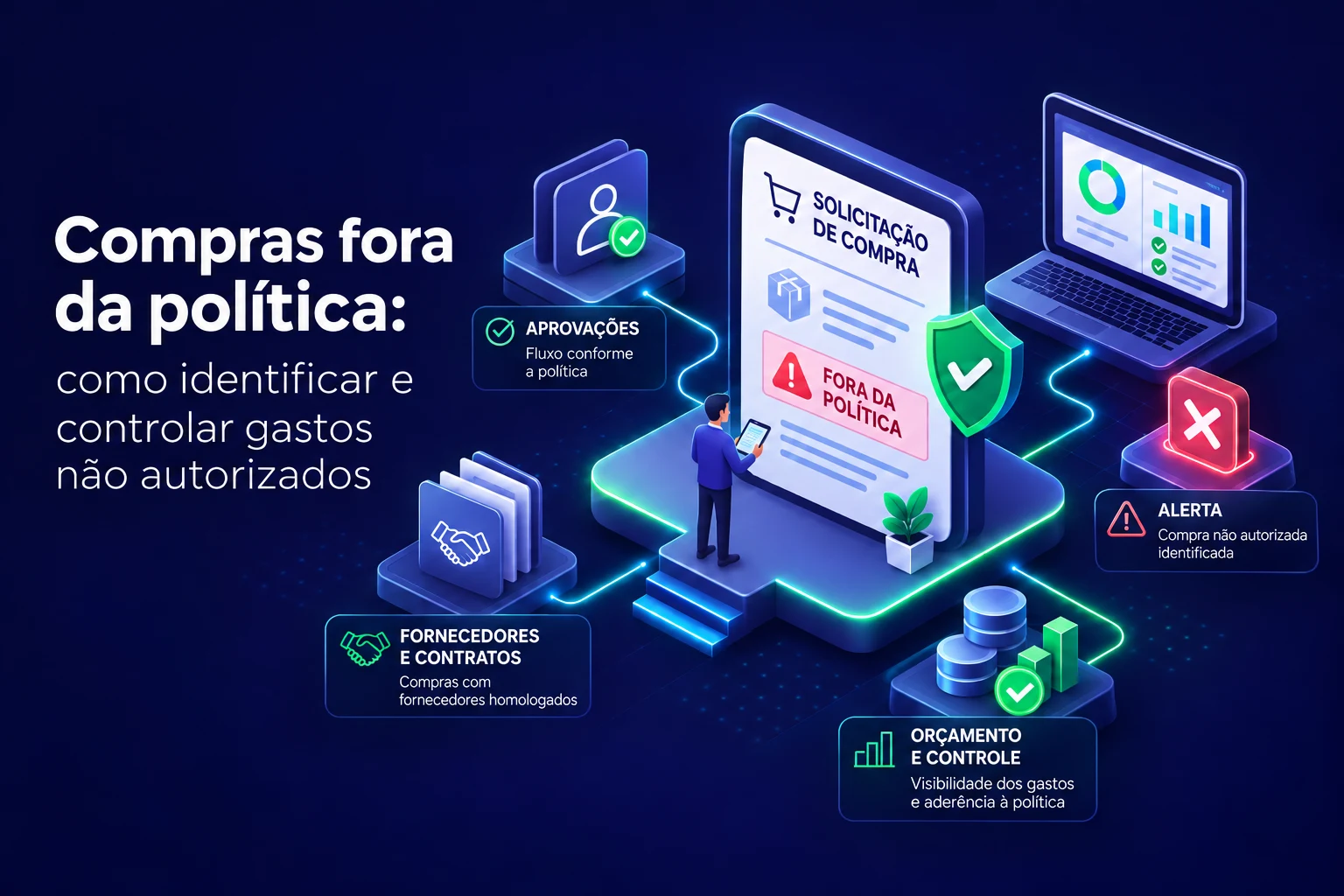
An urgent purchase made without approval, a direct contract that ignores the negotiated supplier, or a service renewal carried out without consulting the Purchasing department may seem like isolated decisions. However, when these situations are repeated, the company loses visibility into its commitments and compromises its spending governance.
Off-policy purchases are acquisitions made in violation of the rules, authorization levels, contracts, or purchasing channels defined by the organization. Also called Maverick buying or maverick spend In the international procurement context, these can include unauthorized spending, unapproved suppliers, and negotiations conducted outside of established procedures.
The problem isn't necessarily the buyer's intention. Often, people seek a quick solution because the formal process is time-consuming, little known, or difficult to use. Therefore, reducing off-policy purchases requires two complementary actions: Identify expenses that fall outside the rules and make the correct path simpler and more efficient..
In this guide, you will understand how to recognize these expenses, measure their occurrence, correct the causes, and connect policies, approvals, and budget in a traceable purchasing process.
What are off-the-books purchases?
Off-policy purchases are transactions that disregard an acquisition procedure applicable to that demand. The violated rule may be related to authorization, budget, supplier selection, use of an existing contract, order formalization, or required documentation.
A simple example: a company has a contract with an equipment supplier, with prices and conditions previously negotiated. A unit purchases the same items directly from another company, without following the mandatory procedure and without a documented justification. Even if the products are needed and delivered correctly, the transaction may represent a purchase outside of company policy.
the term maverick spend The term is used in procurement literature to describe expenditures made outside of approved purchasing channels, contracts, or rules. APQC explains that standardized processes help reduce Maverick buying, precisely because they make the responsibilities and acquisition steps more consistent.
It is important to make a distinction: Not every purchase made outside of a contract is automatically irregular.. There may not be a contract applicable to the category, or the policy may allow for one-off purchases under certain conditions. The classification depends on the rules in force and the context of the transaction.
Are purchases made without approval, outside of contract, and emergency purchases the same thing?
No. These situations may overlap, but they are not synonymous.
| Situation | What characterizes | When it might be a deviation |
|---|---|---|
| Purchase without approval | Purchase made without the required authorization. | When there was a mandatory threshold that was not respected. |
| Purchase outside of contract | Acquisition made without using an existing agreement. | When the contract was applicable and its use was mandatory. |
| Purchase from an unapproved supplier. | Acquisition with partner without validation required. | When the policy requires prior approval. |
| Emergency purchase | Accelerated acquisition due to operational urgency. | When mandatory controls are ignored without using the provided exception. |
| Purchase outside the budget | Commitment undertaken without coverage or release foreseen. | When it exceeds the established limits without authorization. |
An emergency purchase can be fully within policy if there is an exception flow, a defined responsible party, justification, and documentation. The goal of governance is to control risks without paralyzing the business.
Why do companies make purchases outside the formal process?
Before establishing roadblocks, it is essential to understand why areas are circumventing the formal flow. Treating every occurrence as indiscipline can mask real problems in the process design.
Slow processes and unclear approvals.
When no one knows who should approve or how long the decision will take, the applicant may look for shortcuts. A simple request that involves many emails encourages parallel decision-making.
Lack of knowledge about the purchasing policy.
A lengthy policy, published only in a shared folder, hardly guides daily work. Employees need to know what steps to follow, which values require approval, and how to request exceptions.
Decentralized autonomy without visibility
Companies with branches, projects, and different tax identification numbers (CNPJs) can allow for local autonomy. The risk arises when this autonomy is not associated with limits, records, and responsibilities. The solution is not necessarily to centralize all decisions, but... centralize visibility and rules.
Frequent emergencies and insufficient planning
Unexpected maintenance, stock shortages, and last-minute demands require agility. If the company doesn't have a procedure for emergencies, these purchases end up being handled outside the system.
Data fragmented across spreadsheets, messages, and ERP systems.
The ERP system can record the financial commitment or invoice, but this does not guarantee that the requisition, quotation, and approval were conducted according to policy. Without integration between the stages, the deviation may only be noticed after the contract is signed.
A APQC emphasizes that purchases made outside of established procedures are not necessarily faster or more economical. and recommends observing both the controls and the reasons that lead people to avoid them.
What are the risks of unauthorized spending?
The impact goes beyond simply paying more for an item. Unauthorized spending can affect the budget, bargaining power, compliance, and the reliability of management information.
Loss of negotiation opportunities
If different departments separately contract the same service, the company may fail to consolidate volumes, compare proposals, and take advantage of negotiated conditions. This reduces the ability to demonstrate savings achieved by the Purchasing department.
Budget commitment
When a commitment is made before budget approval, the manager may discover too late that part of the budget has already been spent. Predictability is compromised, especially in companies that control spending by unit, project, or cost center.
Contractual and documentary risk
An acquisition without sufficient formalization can generate doubts about scope, deadlines, adjustments, responsibility, proof of delivery, and commercial terms. In certain categories, contracting without verifying supplier documents also increases operational and compliance exposure.
Reduced traceability for audits.
Without a centralized record, it becomes difficult to answer fundamental questions: who requested it, who approved it, which proposals were compared, which supplier was chosen, and why? The absence of this trail limits the analysis of internal controls.
Rework between Purchasing and Finance
An invoice may arrive in the Finance department without a corresponding order or with amounts different from those agreed upon. The effort to discover the origin of the expense occurs after the commitment has already been made.
How can you identify purchases that violate policy in practice?
The first step is to gather evidence, not just look for large payments. A small purchase might be outside the policy, while a high-value acquisition might have followed all the necessary authorizations.
1. Compare orders, notes, and payments.
Look for transactions without a linked request, without an order when it was mandatory, or without a recorded approval. The analysis should consider legitimate exceptions: certain payments may not require the same flow as a regular purchase.
2. Verify applicable suppliers and contracts.
Cross-reference the database of suppliers used with registrations, approvals, and current contracts. Identify categories in which a unit contracted outside the preferred agreement, noting whether the policy required its use.
3. Analyze approvals and authority levels.
Evaluate purchases exceeding defined limits, approvals made by individuals without the corresponding authority, and situations where authorization only occurred after the contract was signed.
4. Investigate repeat or split purchases.
Similar purchases, made in small amounts and within a short period, deserve attention when there are indications of an attempt to circumvent limits. Fractionation should not be assumed solely based on repetition.It is necessary to evaluate the context, timeline, and justifications.
5. Classify the occurrences and validate the exceptions.
Before labeling a transaction as irregular, confirm the applicable rule, the existence of special authorization, and the available documentation. Separate registration errors, justified emergencies, procedural deviations, and potential irregularities that require specific investigation.
Practical example: three units, the same cost.
Imagine a company with three branches that need to hire equipment maintenance services:
- Branch A opens the request, uses the existing contract, and obtains approval.
- Branch B directly contracts the same service, even though a mandatory contract exists.
- Branch C requests emergency assistance, records the reason, and uses the exception procedure outlined in the policy.
In this illustrative scenario, branch B's operation is a candidate for an off-policy acquisition. Branch C may be operating legally, although it has followed an exceptional path. The correct classification depends on an analysis of the rules and records.
How do I calculate the percentage of purchases outside of the policy?
A useful indicator is the spending rate outside of politics, calculated by the proportion of the value of purchases classified as non-compliant in relation to the universe of expenses analyzed.
Suggested operational formula:
Off-policy spending rate (%) = (value of off-policy purchases ÷ total value of eligible spending analyzed) × 100
| Indicator | Illustrative value |
|---|---|
| Eligible expenses analyzed in the month | R$ 800.000 |
| Purchases validated as outside the policy | R$ 64.000 |
| Calculated rate | 8% |
This means that, in the example, 8% of the analyzed value did not fully comply with the required procedures. This does not mean that the company lost 8% of that value., Because spending outside of politics and financial loss are not the same measure.
There are different measurement methodologies. A APQC maintains an indicator of maverick spend in relation to total expenses. For consistent comparison over time, the company should document which categories are included in the denominator, how it identifies deviations, and how it handles exceptions.
| Indicator | What does it reveal? |
|---|---|
| Percentage of purchases without a mandatory order. | Expected frequency of acquisitions without formalization. |
| Expenses with non-approved suppliers | Exposure to partners outside of defined criteria |
| Adherence to existing contracts | Use of negotiated agreements in applicable categories. |
| Average approval time | Potential bottlenecks that encourage shortcuts |
| Emergency purchases per unit | Frequency, value, and recurrence of emergencies. |
| Recurring deviations by category | Where corrective actions can have the greatest effect. |
Track trends, absolute value, and context. A lower rate is desirable, but it doesn't replace analyzing the reasons behind and the quality of decisions.
How to reduce off-policy purchases: a 7-step action plan.
An effective policy needs to be clear to the applicant and controllable for management. The goal is not to add bureaucracy to every purchase, but to prevent deviations and maintain evidence when exceptions are necessary.
Step 1. Define what requires approval.
Specify rules by value range, cost center, unit, expense type, and category. Indicate what can be automatically approved based on predefined criteria and what requires further review.
Step 2. Simplify the purchase request.
The employee needs to find a quick way to register the need, attach information, and track its status. A confusing process increases the likelihood of parallel purchases.
Step 3. Structure the supplier approval process.
Establish which categories require documentary or technical validation and who can grant exceptions. Control should be proportional to the risk of the supply.
Step 4. Link purchases to contracts and budget.
When applicable contracts or budget constraints exist, this information should be available before a decision is made. This reduces the chance of discrepancies only being discovered after the order has been placed or the invoice received.
Step 5. Create a formal procedure for emergencies.
Urgency should not mean a lack of documentation. Define responsibilities, minimum justifications, deadlines for document regularization, and approvals that are compatible with the criticality of the situation.
Step 6. Train applicants and approvers.
A policy only works if people know how to use it. Train teams on the most frequent workflows, applicable limits, and the reasons for the controls.
Step 7. Monitor and correct recurring causes.
Monitor indicators by area, unit, category, and supplier. If many deviations occur at the same stage, review the process design. If the cause is a lack of information, improve communication. If it's a delay in decisions, review the approval workflow.
Purchasing policy, approvals, and budget: how to connect the controls?
Three mechanisms need to work in a coordinated manner:
Purchasing policy: It defines what is allowed, who is responsible, and how to handle exceptions.
Approvals by authority level: They direct decisions to the responsible parties according to criteria such as value, unit, and cost center.
Budget management: It allows you to assess whether the purchase aligns with your defined financial limits and commitments.
When these mechanisms rely on separate spreadsheets and messages, the manager may know the expense amount without knowing the history of the decision. An integrated process organizes the requisition, the comparison of proposals, the authorizations, and the financial commitment before the purchase moves forward.
To understand the complete structure of this process, consult the GOEVO purchasing management guide. For the financial dimension, see the... Budget management solution.
How does GOEVO SCM help control purchases outside of policy?
GOEVO is a platform focused on procurement management and expenditure governance. Its role is to connect people, rules, suppliers, orders, and information in a more organized and traceable flow.
In practice, the GOEVO's purchasing management system It brings together resources that help to reduce the conditions that favor purchases outside of politics:
- Centralized requests: The departments register their needs and monitor the progress of the requests.
- Configurable approvals: Decisions can be made based on criteria such as value, cost center, unit, and defined responsibilities.
- Quotes and comparison chart: Proposals and commercial terms are linked to the process to support more informed choices.
- History and traceability: Requests, proposals, and decisions can be viewed according to access profiles.
- Integrated budget: The budget can be involved in the decision-making process, allowing for monitoring of limits and commitments, according to the contracted configuration.
- Integration with ERP: The platform can connect purchasing operation information to business systems, according to the technical scope of each project.
This doesn't mean that technology alone eliminates all unauthorized spending. Effectiveness depends on a defined policy, appropriate parameters, consistent use, and monitoring by those responsible. The advantage is no longer relying exclusively on manual controls to guide and record the process.
Do you want to increase visibility into purchases and reduce out-of-flow decisions? Talk to the GOEVO team and learn about the platform..
Checklist: Can your company identify expenses that deviate from policy?
Use these questions in an initial assessment:
- Is there an up-to-date and accessible purchasing policy?
- Do employees know how to request goods and services?
- Does each type of purchase have clear responsibilities and authority levels?
- Is it possible to identify who approved it and when?
- Can the company distinguish between regular purchases and justified exceptions?
- Do the suppliers required by the policy undergo approval?
- Is there visibility into purchases made outside of applicable contracts?
- Is the finance department able to link expenses to requests and approvals?
- Are budget constraints considered before making commitments?
- Do the indicators allow for the analysis of deviations by unit, category, and area?
If several answers are negative, the next step is to map the current process and establish a control baseline—before trying to solve everything with additional rules.
Frequently asked questions about purchases outside of the policy.
What does "maverick spend" mean?
Maverick spend This term refers to expenses incurred outside of approved policies, contracts, or purchasing channels. In Portuguese, it can be described as "compras fora da política" or "gastos não conformes com o procedimento de compras.".
Is every purchase without a contract illegal?
No. The company may allow one-off purchases in certain categories and amounts. Irregularity depends on the existence of an applicable rule and its breach. When a mandatory contract is ignored, there is a possible deviation to be investigated.
How to identify an unauthorized purchase?
Compare the requisition, order, approval, supplier, and payment records with the current rules. An expense without required approval is a significant red flag, but the process should consider formally authorized exceptions.
How to avoid emergency purchases outside of the established process?
Create a fast exception workflow, with criteria, responsible parties, and minimal evidence. This way, the company gains agility without losing traceability or control over commitments.
What is the main indicator of non-political spending?
The off-policy spending rate is an important indicator: it relates the value of transactions validated as non-compliant to the total spending considered. Its usefulness depends on a consistent methodology and analysis of the causes of the deviations.
Can a purchasing system replace an ERP?
Not necessarily. A specialized purchasing system organizes the steps before and after negotiation, such as requisitions, quotes, approvals, and orders. It can work integrated with the existing ERP, respecting the design of each project.
Conclusion: Spending governance begins before payment.
Controlling purchases outside of policy isn't just about looking for unauthorized expenses at the end of the financial year. It's about establishing an operation where needs are recorded, rules are clear, exceptions have responsible parties, and management can track commitments before they become expenses.
By combining simple procedures, proper approvals, centralized data, and consistent indicators, the company reduces its dependence on isolated decisions and creates conditions to negotiate better, protect its budget, and improve its management capacity.
That is the logic of spending governanceTransforming information and control into more informed purchasing decisions.
About the author
Welington Humberto He is the CEO of GOEVO, a technology company specializing in procurement management and expense governance. He shares his vision on business management, innovation, and the evolution of procurement processes. Follow Welington Humberto on LinkedIn.
Sources and further reading
- APQC — Apply Consistent Procurement Processes to Reduce Maverick Buying. Published in January 2025.
- APQC — Maverick Purchasing Means Slower, More Costly Purchases.
- APQC — Annual value of unmanaged/maverick spend as a percentage of total spend. Definition of an indicator for methodological reference.
- CIPS — Why now is the right time to tackle maverick spend.