



If you've ever tried to approve a purchase order via WhatsApp, you know how that process ends: the message disappears in the history, the approver doesn't see it, and the purchase goes through without authorization. Meanwhile, spreadsheets with dozens of tabs struggle to keep track of the budget, suppliers, and open orders, but no one is sure which version is the most up-to-date. The problem isn't a lack of effort from the team. It's a lack of structure, and that's exactly what an online purchasing system solves.
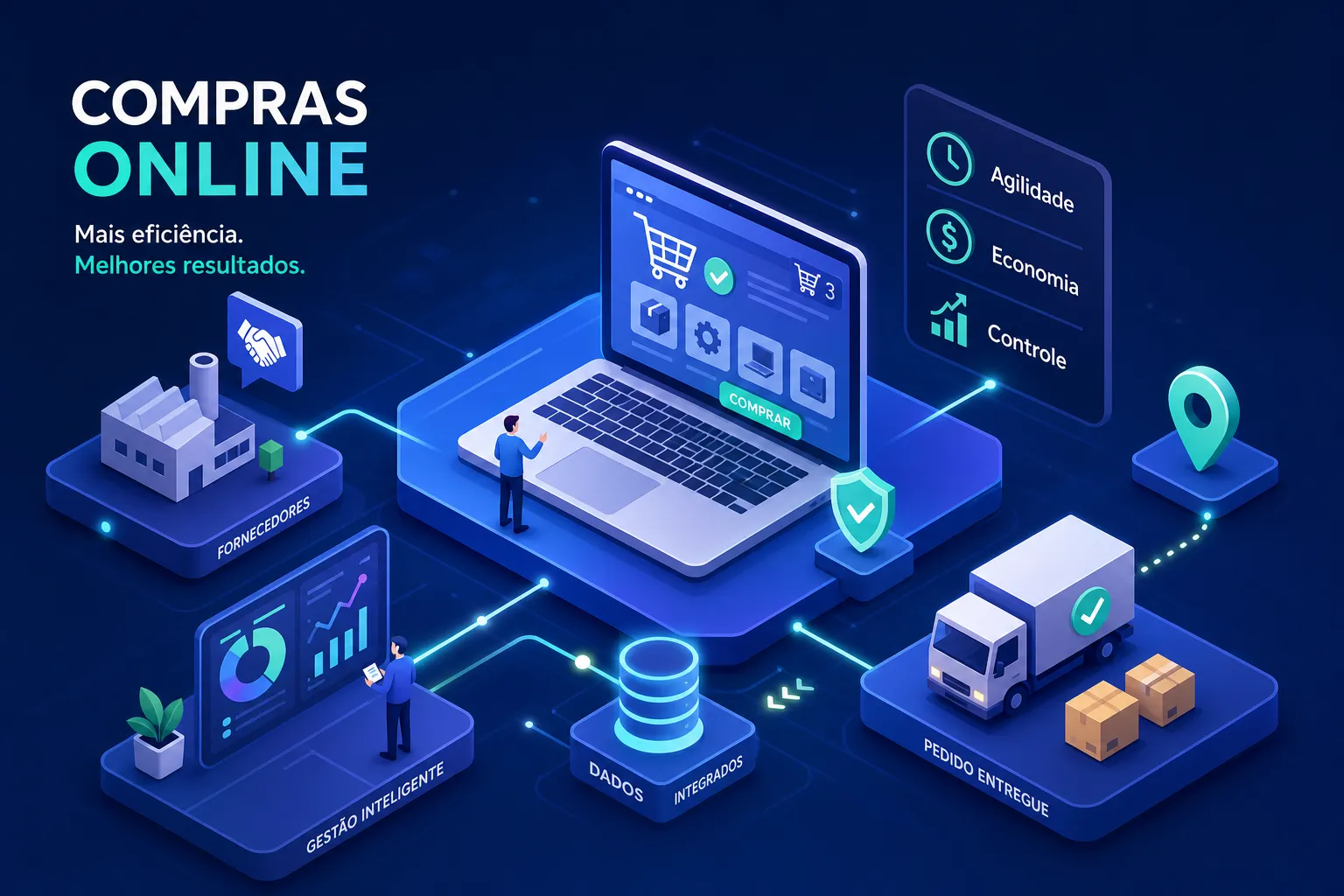
A corporate purchasing platform digitizes and automates the entire procurement cycle, from request to receipt, within a single environment with full traceability. Goevo, for example, centralizes orders, suppliers, contracts, inventory, and budget in one place, serving medium and large-sized companies throughout Brazil. In this guide, you will understand which functionalities are indispensable, how to evaluate integration with your ERP, and what to ask before signing any contract.
What is an online shopping system in practice?
There's a common misconception here: an online shopping system is not a website for placing orders. like in e-commerce. It is a digital environment that organizes and automates the complete corporate procurement cycle, from internal requisition to supplier payment. The central objective is to provide total visibility into what is being purchased, from whom, for how much, and with what documented approval.
Digitizing and automating are different things. Digitizing means moving the process to the computer without changing the logic: the spreadsheet goes to the cloud, but approvals still depend on someone remembering to reply to the email. Automating means creating workflows that work without manual intervention; the request is submitted, the approver receives a notification, approves or rejects it in the system, and the history is automatically recorded. This difference defines whether the company will actually gain control or just switch tools.
Why spreadsheet management reaches its limit.
The bottlenecks in spreadsheets are not abstract. Conflicting file versions circulate via email, approvals get lost in the inbox, the recorded budget doesn't reflect orders still in progress, and any attempt at auditing requires hours of manual work. Market research indicates that a manually processed purchase order can cost between US$75 and US$150, while the same order in an automated system costs less than US$35. This invisible cost accumulates month after month without appearing in any report.
Medium-sized companies They feel this effect more intensely because the volume of purchases is already high enough to create chaos, but the control structure is still informal. Surveys from 2025 indicate that approximately 391% of micro, small, and medium-sized enterprises (MSMEs) still... They controlled expenses manually., ...with spreadsheets and analog processes. Adopting an electronic purchasing system is the way to end this cycle.
Isolated transaction versus structured purchasing process
Buying from a supplier via an online store is an isolated transaction. Having a digitized corporate purchasing process means controlling who is authorized to buy, what can be purchased, within what budget, and with what level of approval, regardless of where the supplier is located. The system is not the shopping cart: it's the governance that ensures every real spent has been approved, recorded, and is aligned with the available budget.
Essential features for an online shopping system
The most common mistake when evaluating tools is comparing lists of features without understanding what problems each one solves. The following features are organized by the most frequent problems in corporate purchasing: lack of control, informal approvals, disorganized suppliers, and invisible budget.
Order approval and control workflow
A configurable approval workflow eliminates the chaos of informal authorizations and creates real traceability. Each request has a history: who requested it, who approved or rejected it, when, and why. Without this, unauthorized purchases happen frequently, and no one can prove otherwise afterward. The ability to configure approval levels by value, cost center, or purchase category is what transforms approval into control, not bureaucratic formality.
Supplier management and budget comparison
Centralizing supplier registration with documentation, negotiation history, and approval status improves the quality of purchasing decisions. When a buyer needs to quote an item, they access already qualified suppliers, send the quote request through the system, and compare the responses in the same environment. This process, which previously took days via email, can now be resolved in hours with a complete history of each negotiation, although the exact gain varies depending on the operation.
Integrated budget and performance indicators
The budget needs to be connected to the purchasing process in real time. If there are no funds available for that cost center, the order does not proceed, provided the platform is properly configured with your company's rules. This automatic blocking eliminates an entire class of unauthorized expenses that currently go unnoticed until the end of the month. Furthermore, dashboards with key indicators of savings, order volume, and supplier performance transform operational data into strategic information for the financial manager and the purchasing director.
How Goevo works in practice: an environment for the entire cycle.
Goevo was built to solve exactly the problems described above, with one important difference: everything happens within a single environment, without the need for multiple tools connected by improvised adaptations. The platform covers the complete purchasing cycle Corporate-focused and developed for the Brazilian market, it supports electronic invoicing (NF-e), average cost calculation according to national legislation, and LGPD compliance features, as per the product's technical documentation.
From request to receipt, all within the system.
The workflow within Goevo begins with the purchase request and ends with the receipt of the invoice and inventory update. Along the way are supplier quotations, approval according to configured limits, purchase order issuance, and integration with electronic invoicing (NF-e). Each step is traceable and auditable, meaning any purchase decision can be revisited months later with complete context, without needing to sift through old emails or spreadsheets.
What changes for teams that abandon spreadsheets?
Companies that have migrated to Goevo report concrete impacts: real-time visibility Cost center breakdowns, reduced approval times, and budget control that works before the money is spent, not after. The platform's significant adoption reflects continuous daily use, not just signed contracts, and when a system solves the right problem, teams incorporate it into their routine naturally.
ERP integration: the criterion that defines the success of the implementation.
A purchasing platform that doesn't integrate with the existing ERP creates a second, isolated data repository. The buyer enters the order into the purchasing management system, and someone needs to manually replicate it in the ERP for the finance department. This negates much of the efficiency gain and opens the door to typing errors, manual reconciliations, and inconsistent reports. ERP integration is not a differentiator: it's a requirement.
The most common technical models are REST APIs for real-time synchronization and EDI files for batch data in legacy environments, in addition to intermediate integration layers to orchestrate the exchange between more complex systems. For the non-technical manager, what matters is knowing which data is synchronized: supplier registration, purchase orders, invoices, cost centers, and inventory movements. If any of these points require manual entry in both systems, the integration is not complete.
How does integration with SAP, TOTVS, and other Brazilian ERPs work?
In the mid-sized market in Brazil, the most used ERPs are TOTVS Protheus, SAP Business One, Senior, and Sankhya. Goevo offers integration with SAP, TOTVS, and other national systems, synchronizing registrations, orders, invoices, and inventory movements. Consult the technical documentation to verify the connectors available for your environment. This integration allows the purchasing management software to function as a specialized layer without replacing the ERP, complementing functionalities that legacy systems do not cover with the same depth.
The hidden cost of duplicated operations.
When integration is lacking, the company operates two systems in parallel. Data manually entered into both environments generates discrepancies that only appear in monthly reconciliations, and then rework is inevitable. This cost rarely appears in return on investment analysis spreadsheets, but it is present every day in the team's working hours. Therefore, ERP integration should function as an elimination criterion in the evaluation of any platform: if it doesn't integrate, it doesn't advance to the next phase of the analysis.
Checklist for choosing the right online shopping system
Here's a practical filter for evaluating any e-commerce solution using the criteria that truly matter. It's not a list of generic features; these are questions you should be able to answer about each platform before making any decision.
Functional and technical criteria for comparing platforms
Evaluate each platform by answering these questions:
- Does the platform cover the complete purchasing cycle: request, quote, approval, order, receipt, and inventory update?
- Is the approval workflow configurable by authority level, cost center, and category?
- Does the budget automatically block requests when there are no funds available?
- Is there real integration with the ERP system the company already uses?
- Was the system developed to comply with Brazilian legislation, including NF-e (electronic invoice), average inventory cost, and LGPD (Brazilian General Data Protection Law)?
- Are the supplier performance and cost indicators generated automatically?
If any of these questions generate a vague answer or a "yes, but with additional customization," that's a warning sign. Features that require extra development for your company's case rarely arrive on time and within budget.
Essential questions before signing the contract.
These points rarely appear in the sales presentation, but they define whether the implementation goes well:
- What is the actual implementation timeline, with milestones and deliverables defined in the contract?
- How is the migration of historical data from suppliers, contracts, and orders done?
- What level of post-implementation support is offered and how is it contracted?
- Is there an additional cost per module, per number of users, or per order volume?
- Does the supplier have documented case studies of companies of the same size and sector?
Precise answers to these questions separate vendors with real implementation experience from those who sell well but deliver poorly. Ask for references from active clients, not just website case studies.
The right decision starts with the right criteria.
An efficient online purchasing system isn't about technology for technology's sake. It's about giving managers real control over what the company spends, how it spends, and with whom. When this control exists, the budget ceases to be a historical reference and becomes an active decision-making tool.
To make the right choice, evaluate four key areas: functionalities that cover the entire lifecycle; genuine integration with the existing ERP system; a budget that is linked to the process in real time; and compliance with Brazilian regulatory requirements. Any solution that doesn't adequately address these points will create new problems while solving existing ones.
If you want to see these criteria applied in practice, Goevo was built precisely for that: a complete purchasing cycle, developed for the Brazilian context, without needing to adapt the company to a generic solution created for another market. It's worth exploring before making any decision.