

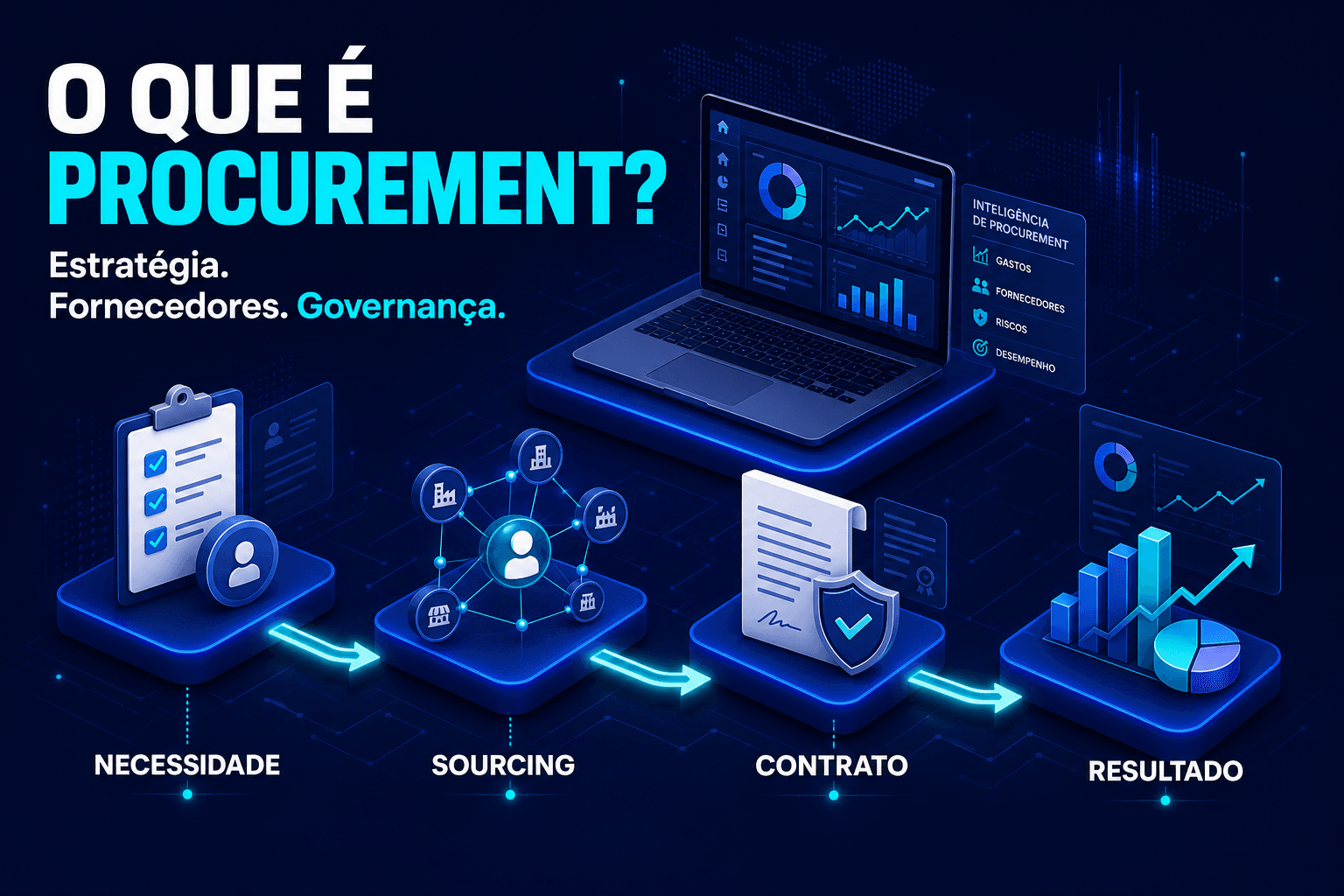
Procurement is the business function that identifies needs, defines supply strategies, selects and develops suppliers, negotiates terms, manages contracts, and monitors the execution and performance of acquisitions. Its goal is not just to pay less: it is to obtain the best value for the business, with quality, availability, risk control, compliance, and responsible use of resources.
Direct answer: Purchasing is the transactional part of acquiring a material or service. Procurement is the broader discipline that governs why to buy, what to buy, from whom to buy, under what conditions, and how to track the outcome. In a mature company, procurement connects strategy, budget, suppliers, contracts, orders, receipts, and financial data.
To delve deeper into the operational layer, see also the Complete guide to purchasing management..
In summary
- Procurement is broader than just purchasing: It includes planning, market analysis, sourcing, negotiation, contracts, suppliers, risk, and performance.
- Buying is one step: Requisition, approval, order, receipt, and payment are part of the execution, but they do not represent the entire process.
- The goal is to generate total value: Price matters, but it must be analyzed in conjunction with quality, lead time, risk, productivity, innovation, and lifecycle cost.
- Governance does not mean bureaucracy: It means giving visibility, context, and accountability to spending decisions.
- ERP and procurement must work together: An ERP system can cover a significant portion of the journey; a specialized platform can fill gaps in experience, collaboration, governance, and integration.
- Responsible personalization is important: Policies, levels of authority, categories, contracts, and integrations need to reflect the company's reality without turning every exception into development.
Summary
- What is the concept of procurement?
- Why do we use the term in English?
- What are the objectives of procurement?
- Procurement and purchasing: what's the difference?
- Related terms
- Types of procurement
- Process steps
- Spending governance
- Indicators
- Technology, ERP and customization
- How to know if the area is ripe?
- Frequently Asked Questions
What is the concept of procurement?
O Chartered Institute of Procurement & Supply — CIPS Procurement is defined as the acquisition of goods and services that enable an organization to operate its supply chains profitably and ethically. The same definition broadens the process from identifying a need to terminating a service contract or reaching the end of an asset's useful life.
This breadth is the central point. Procurement doesn't begin when the buyer requests three quotes and doesn't end when the order is placed. The function participates in decisions both before and after the transaction.
- to understand and validate the need;
- deciding between producing internally or outsourcing;
- Analyze the market, category, and risks;
- to find and qualify suppliers;
- to structure an appropriate competition;
- Negotiate price and other conditions;
- To formalize and manage contracts;
- To guide requests, approvals, and orders;
- Track delivery, quality, and payment;
- to evaluate supplier results and performance.
An operational definition of GOEVO
Procurement connects strategy, suppliers, contracts, processes, and spending so that each acquisition generates value and remains controllable from intention to completion.
This phrase is an editorial summary from GOEVO, not a normative definition. It highlights something especially important for medium and large companies: controlling spending is not just about knowing how much was accounted for. It's about understanding how the commitment arose, what policy was applied, who decided, what alternatives were analyzed, and what was actually delivered.
Is procurement an area, a process, or a competency?
It could mean all three:
- Area: The team responsible for categories, suppliers, negotiations, contracts, and policies.
- Process: A set of steps that transforms a need into supply and result.
- Organizational competence: The ability to use supplier markets and business relationships to generate value and protect operations.
In smaller companies, these responsibilities may be concentrated in a few people. In larger organizations, they usually involve Purchasing, technical areas, Operations, Finance, Tax, Legal, Compliance, IT, and the suppliers themselves.
Why do we use the term "procurement" in English?
In business Portuguese, "compras" can refer to both the entire area of purchasing and the act of buying itself. This makes the conversation ambiguous. The use of "procurement" has gained ground to represent a more comprehensive and strategic view, while "purchasing"—often translated as compras—describes the transactional execution.
The English term doesn't, in itself, make the practice more sophisticated. A company can call its department Procurement and continue operating via email, spreadsheets, and reactive decision-making. What characterizes the evolution is the real scope of the function, its processes, data, responsibilities, and results.
In Portuguese texts, the clearest approach is to explain the term the first time it occurs and then use it when the strategic distinction is relevant.
What are the objectives of procurement?
The goal of procurement is to ensure that the company obtains the external goods, services, and capabilities it needs, under the most suitable conditions for the business and over the right timeframe. This involves more than just price reduction.
1. Ensure availability and continuity
The company needs to receive the correct item or service, on time and at the required location. An apparent saving loses value when it causes downtime, project delays, service disruptions, or unavailability of a critical service.
Procurement focuses on supplier capacity, deadlines, supply alternatives, inventory levels, contractual terms, and contingency plans.
2. Maximize the total value of the acquisition.
Unit price is only one part of the equation. The decision may consider freight, taxes, installation, consumption, maintenance, quality, warranty, productivity, disposal, and the cost of switching suppliers. This reasoning is usually associated with... total cost of ownership, or TCO.
“"Best offer" does not automatically mean "lowest price." It means the alternative that delivers the best balance between benefit, cost, and risk for the defined criteria.
3. Manage expenses with visibility.
Procurement transforms dispersed transactions into a single view by category, supplier, unit, cost center, contract, and project. This visibility allows for consolidating demands, reducing duplication, identifying risk concentrations, and negotiating with better data.
4. Reduce risks and strengthen compliance.
This function helps verify registration, technical, financial, tax, contractual, privacy, integrity, and continuity requirements, according to the risk of each contract. It also organizes policies, approval levels, bidding processes, justifications, and segregation of duties.
The goal is not to apply the same bureaucracy to every purchase. It is to create controls that are proportionate to the value, criticality, category, and potential impact.
5. Develop suppliers and improve performance.
Selecting the supplier is the beginning of the relationship. Procurement involves monitoring deadlines, quality, service level, discrepancies, capacity, innovation, and improvement plans. Strategic suppliers require different governance than occasional suppliers or those providing standardized items.
6. Support innovation and sustainability
Suppliers can bring new technologies, materials, service models, and process alternatives. Procurement brings this knowledge closer to internal areas and transforms innovation into enforceable criteria, tests, and contracts.
A ISO 20400:2017, The ISO standard, confirmed as valid, provides guidance for integrating sustainability into procurement decisions and processes in organizations of any size or activity.
7. Improve process efficiency.
Complete requests, consistent approvals, reusable data, structured quotes, accessible contracts, and ERP integration reduce retyping, waiting, and rework. Automation is valuable when it removes tasks without eliminating the necessary judgment.
Procurement and purchasing: what's the difference?
Procurement is the overarching discipline; purchasing is a part of its execution. Both CIPS as for SAP They describe procurement as an ongoing, long-term approach, while purchasing focuses more directly on acquisition, ordering, delivery, and payment.
| Dimension | Procurement | Shopping or purchasing |
|---|---|---|
| Scope | From need to strategy, to supplier, to contract, to execution and performance. | From requisition and acquisition to receipt and payment. |
| Guidance | Strategic and tactical | Predominantly operational and transactional |
| Horizon | Continuous and medium or long term. | Linked to a transaction or order cycle |
| Central question | How to generate the best value and protect the business? | How do I correctly acquire what was requested? |
| Criteria | Total value, risk, quality, innovation, sustainability, performance, and cost. | Price, deadline, quantity, order compliance and efficiency. |
| Suppliers | Research, segmentation, approval, development, and relationship building. | Quotation, order, delivery, discrepancy and payment |
| Contracts | Strategy, negotiation, obligations, performance, renewal and termination. | Application of the terms and conditions in the purchase. |
| Data | Market, category, expenditure, risk, contract, and performance. | Request, order, receipt, invoice, and payment. |
| Result | Sustainable value and governance of spending | Transaction completed successfully. |
Shopping remains an essential function.
Calling procurement "strategic" doesn't make purchasing any less important. An excellent strategy fails when the order uses the wrong price, approval doesn't happen, the receipt isn't recorded, or the invoice gets blocked.
The correct point is not to pit one activity against the other. It's to understand that Purchasing plays an indispensable role in the procurement strategy..
Practical example
Imagine a company needs to hire maintenance services for 20 units:
- Shopping Collects the request, obtains proposals, issues the order, and tracks the delivery.
- Procurement It questions whether the demands can be consolidated, defines the scope and SLA, evaluates the market, segments suppliers by region, models price and risk, negotiates the contract, creates the activation policy, measures performance, and prepares for renewal.
The two perspectives converge in execution. Without purchasing, strategy doesn't translate into action; without procurement, transactions can remain isolated and reactive.
Procurement, sourcing, supply chain, e-procurement, P2P and S2P
These terms appear together, but they are not synonyms.
| Term | Practical meaning | Relationship with procurement |
|---|---|---|
| Sourcing | Research, analysis and selection of supply sources. | It's a capability within procurement. |
| Strategic sourcing | A structured approach to market, spending, category, negotiation, and suppliers. | It deepens the supply decision. |
| Purchasing | Request, approval, order, receipt, and payment. | It is the transactional execution of the acquisition. |
| Procure-to-pay (P2P) | It integrates purchasing and accounts payable, from order to payment. | It primarily represents the executive and financial aspects. |
| Source-to-pay (S2P) | It goes from need and selection to contract, purchase and payment. | It's a broad digital view of the procurement journey. |
| E-procurement | Use of software to support and automate procurement activities. | It is the technological layer of the process. |
| Supply chain | Network and management of material, service, information and operational flows. | It has a broader scope; procurement governs external relations and acquisitions within it. |
| SRM | Supplier relationship management | Supplier relationship, risk and performance management |
| CLM | Contract lifecycle management | Contract lifecycle management |
A SAP defines source-to-pay. like the process that begins with need and ends with payment. However, procure-to-pay It integrates procurement with accounts payable systems and includes selection, compliance, receipt, reconciliation, invoicing, and payment.
To delve deeper into the technological layer, also read E-procurement: what it is, how it works, and why it's transforming procurement management..
What are the main types of procurement?
Direct Procurement
This encompasses inputs that go directly into the company's main product or service. Raw materials, components, and packaging are industrial examples. Availability, specifications, quality, and continuity usually have an immediate impact on production and revenue.
Indirect procurement
It includes goods and services that support operations without directly becoming part of the final product: maintenance, technology, facilities, marketing, travel, office supplies, and professional services.
Indirect costs can be spread across many areas and suppliers, which increases the importance of simple policies, catalogs, contracts, and consolidated visibility.
Procurement of services
Services require special attention to scope, deliverables, hours, service levels, measurements, and acceptance. Control doesn't end with the signature: it's necessary to link the contract, execution, evidence, measurement, invoice, and payment.
Procurement of goods
It involves physical items and may include direct or indirect acquisition. Specification, unit of measure, quantity, storage, transport, inspection, warranty, and disposal are relevant elements.
CAPEX and OPEX
CAPEX and OPEX do not replace the previous categories; they classify the economic nature of the expenditure. Acquisitions of assets and capital projects may require different business cases, budgets, milestones, measurements, and governance than recurring operating expenses.
O CIPS It highlights the distinctions between direct and indirect procurement, goods, and services. The internal taxonomy should reflect how the company plans, decides, and analyzes its spending.
What are the steps in the procurement process?
O CIPS Procurement and Supply Cycle It has 13 steps. To facilitate business application, GOEVO organizes below an operational summary in ten steps. It is not a universal standard: the flow should vary according to category, risk, value and sector.
1. Identify and validate the need
The requesting department describes the problem, the expected result, the deadline, the quantity, the specification, and the justification. Procurement verifies if the demand is necessary, if it can be met by stock, a current contract, a catalog, or an internal solution, and if it aligns with the planning.
A poorly defined request contaminates all subsequent steps. Quality begins before the quote.
2. Relate demand, budget, and category.
The need is associated with the unit, cost center, account, project, contract, and category. The company verifies budgetary availability and consolidates similar demands when this generates an advantage.
This is the first link in the governance of spending: the intention gains economic context before becoming a commitment.
3. Analyze spending, market, and risk.
Procurement studies historical data, volumes, prices, suppliers, dependencies, market capacity, risks, and alternatives. The analysis determines whether the priority is competition, continuity, standardization, innovation, risk reduction, or another source of value.
4. Define the supply strategy
The team decides how to approach the market: open or closed bidding, RFI, RFP, RFQ, auction, negotiation, emergency contracting, or duly justified single source. It also defines lots, criteria, weights, deadlines, and governance of the decision.
The method must be appropriate to the subject matter. A simple price quote may work for a standardized item; a complex service may require a technical proposal, presentation, proof of concept, and contract negotiation.
5. Research, register, and qualify suppliers.
Potential suppliers are identified and evaluated through a supplier approval Proportional to the risk. Tax registration, technical capacity, financial situation, security, integrity, sustainability, documents and references may be part of the analysis.
Qualification should not be a one-size-fits-all, undifferentiated process. A critical provider with access to data or facilities requires different controls than a casual, low-risk supplier.
6. Conduct sourcing, evaluation, and negotiation.
Participants receive equivalent information, submit proposals, and respond to clarifications. The evaluation considers the defined criteria and records versions, decisions, and justifications.
Negotiation includes price, but also deadlines, quality, readjustment, payment, warranty, capacity, service level, responsibility, innovation, and risk.
7. Formalize the contract, catalog, or commercial terms.
The result is converted into an executable instrument: contract management, The order form, catalog, table, agreement, or other specified form must be clearly defined. Roles, obligations, validity, readjustment, limits, SLA, penalties, and the change process must be clear.
The contract only generates value when its terms are implemented in the transaction. Saving the PDF without linking it to the request, order, and measurement preserves the document, but does not govern its use.
8. Request, approve, and issue the order.
The user purchases through the designated channel. The request goes through quotation, approval processes, and applicable validations; then, the order is issued and sent to the supplier.
At this stage, purchasing executes the procurement decision. Flows must be controlled and, at the same time, simple enough so that departments do not seek parallel paths.
9. Receive, check, measure and pay
The company confirms the material, service, or contractual milestone. Orders, receipts or measurements, and invoices are reconciled; discrepancies follow a workflow with assigned responsibility and deadlines. ERP and financial systems typically play a central role in accounting and payment processing.
10. Evaluate performance and provide feedback to the strategy.
Deadlines, quality, service, discrepancies, risk, innovation, and contract compliance feed into scorecards and future decisions. The area confirms benefits, reviews the contract, decides on renewal, executes an improvement plan, or prepares a new tender.
Procurement is cyclical: the result of one purchase improves — or should improve — the next decision.
How does procurement connect to spend governance?
Spending governance is the ability to track company money from intention to actual expenditure, preserving context, accountability, and evidence.
A simplified view of the journey is:
Need → Budget → Sourcing → Contract → Requisition → Approval → Order → Receipt or Measurement → Note → Payment → Performance
Financial record-keeping is essential, but it only becomes apparent after a significant portion of the decisions have already been made. Therefore, procurement needs to connect three perspectives:
1. Intention
What does the area need, why, when, and for what result? Was there an internal alternative, a contract, or stock? Is the specification adequate?
2. Commitment
Which supplier was chosen, under what conditions, by whom, and within what budget? Do the contract and the order reflect what was approved?
3. Done
What was delivered, measured, invoiced, and paid for? Were there any discrepancies? Did the supplier fulfill the agreement? Was the expected benefit achieved?
Governance is not synonymous with hindering operations.
An overly complex process encourages shortcuts. An uncontrolled process leaves the company without visibility. Good governance applies proportionate rules and makes the correct route simpler than the informal exception.
In practice, this means:
- Approval levels based on value, category, unit, project, or risk;
- segregation of duties;
- budget visible at the time of decision;
- valid suppliers and contracts;
- registered bids and justifications;
- Emergency or unique exceptions with their own treatment;
- History of changes and approvals;
- reconciliation between order, receipt and invoice;
- Adoption, process, and value indicators.
Which procurement indicators should you track?
A balanced dashboard doesn't just measure economics. It combines coverage, efficiency, compliance, supplier, and value.
| Indicator | What does it reveal? | Careful interpretation |
|---|---|---|
| Spending under management | Portion of addressable spending covered by procurement process and strategy. | Clearly define what constitutes addressable spending and what it means to be under management. |
| Contractual expense | Use of negotiated contracts or terms | The existing contract does not prove that the price, limits, and obligations were met. |
| Purchases outside the process | Demands that bypass channels, policy, or approval. | Distinguish between legitimate emergency and lack of adherence. |
| Cycle time | Speed between milestones, such as request completion and order. | Use the median and segment by category or complexity. |
| Competitive coverage | Eligible parcel subject to appropriate competition | More proposals do not automatically mean a better decision. |
| First-time-right | Processes completed without return or correction. | Identify the cause: data, rule, user, vendor, or integration. |
| Order automation | Transactions that flow without undue manual intervention. | Automation should not hide exceptions or loss of control. |
| Supplier performance | Deadline, quality, SLA, occurrence and progress | Criteria need to be objective and appropriate to the category. |
| Savings achieved | Benefit effectively reflected in the acquisition | Differentiate between negotiated savings, realized savings, and cost avoidance. |
| Discrepancy between order–receipt–invoice | Quality of execution and integration | Track the cause and resolution time, not just the volume. |
There is no universal target for these indicators. The company must establish a baseline, segment comparable populations, and define the behavior it intends to improve.
What is the role of technology, ERP, and personalization?
Procurement can exist without a specialized platform, but it loses scale when information is scattered across spreadsheets, emails, messages, portals, and systems without integration.
What procurement technology should organize
A platform can connect:
- Guided requisitions and purchasing;
- budget and budgetary availability;
- Sourcing, RFQs, RFPs, and auctions;
- suppliers, documents, risk and approval;
- comparative maps and negotiations;
- contracts, terms, adjustments and consumption;
- levels of authority and approvals;
- Orders and confirmations;
- receipts, measurements and notes;
- Indicators, auditing, and performance.;
- communication with users and suppliers;
- Automation and artificial intelligence in appropriate tasks.
O CIPS defines e-procurement such as the use of software systems to support procurement activities and automate previously manual processes. Technology, however, does not alone correct confusing policies, inconsistent registration data, or undefined responsibilities.
In PwC's 5th Global Digital Procurement Survey, According to a survey that included more than 1,000 companies in nearly 60 countries, the consulting firm reports that organizations have begun to prioritize business criteria—such as requirements and processes—when implementing digital solutions, in addition to recognizing user adoption as a success factor. This is a result from the sample surveyed, not a universal rule, but it reinforces the importance of starting with the process and not the tool.
ERP is part of the solution, not an adversary.
A Oracle Note that ERPs manage activities such as accounting, procurement, projects, risk, and supply chain management, and integrate data across processes. Therefore, it is incorrect to say that all ERPs are limited to recording orders and invoices; modern suites can offer advanced procurement capabilities.
The appropriate question is: What capabilities does the current environment adequately address, and what gaps still exist?
A specialized platform tends to make sense when a company needs to improve collaboration with suppliers, the requester experience, sourcing, contracts, budget, approval levels, traceability, or distributed operations without replacing its core fiscal, accounting, and financial functions.
In GOEVO's narrative, the integration should preserve the ERP and extend its capabilities:
- The ERP system remains the reference point for registration, accounting, tax, inventory, or finance, depending on the architecture;
- Procurement organizes the journey, the decisions, and the collaboration that lead to spending.;
- Identifiers, data, and statuses need to circulate without retyping;
- Integration errors should be visible, treatable, and reconcilable.
Why personalization matters — and where it should stop.
Companies differ in units, projects, cost centers, categories, contracts, risks, authority levels, and ERPs. Forcing them all to operate through a generic workflow can transfer the process outside the tool's scope.
Responsible personalization adapts:
- Required forms and data;
- policies, levels of authority and replacements;
- Routes by category, value, and risk;
- roles and visibility;
- Approval documents and criteria;
- contracts, measurements and approvals;
- specific integrations and business rules.
This doesn't mean developing a different version for every preference. The healthy approach is: adopt product best practices, configure what's possible, integrate with sustainable standards, and customize only when the need creates value or meets a relevant requirement.
This combination — governance, integration and adherence to context This is especially important in industries, distributors, hospitals, dealerships, construction companies, field operations, and companies with multiple branches, projects, or cost centers.
How can you tell if a company has a mature procurement process?
Maturity is not about the number of people involved or the name of the field. It's the ability to repeat good decisions and learn from the results.
Signs of low maturity
- Requests arrive via email or message without standardized specifications;
- Purchasing only takes place after the supplier has already been chosen;
- quotations do not preserve criteria, versions, and justifications;
- There is no reliable view of spending by category and supplier;
- Contracts are filed away without any control over consumption, validity, or obligation;
- Approvals depend on manual processing;
- Supplier registration and documentation are scattered;
- Order, receipt, and invoice require retyping;
- Savings information is provided without a baseline or financial confirmation.;
- Supplier performance does not influence new decisions.
Signs of progress
- The areas involved include procurement in the planning phase;
- Categories have strategies that are proportional to value and risk;
- Demands, budget, and contracts are connected;
- Suppliers are segmented and monitored;
- The purchase path is clear to the user;
- Exceptions are brief, but justified and measured;
- ERP and platform exchange data in a monitored manner;
- Indicators distinguish adoption, efficiency, compliance, and value;
- Purchasing involves dedicating less time to manual consolidation and more to analysis and negotiation;
- The result of each cycle improves the next.
A Deloitte's global CPO survey of 2025 The study found an association between the combination of technology and people's skills and improved business performance. The prudent conclusion is that maturity requires technology and talent working together; software in isolation does not constitute transformation.
How to structure procurement in a medium-sized company?
A medium-sized company doesn't need to copy the structure of a multinational corporation. It needs to prioritize the controls and capabilities that address its complexity.
A practical approach is:
- Map expenses, categories, units, contracts, and suppliers;
- Define policy, roles, levels of authority, and exceptions;
- Establish a single point of entry for requests;
- Connect the budget to the request and approval process;
- Standardize sourcing and decision maps;
- Organize supplier registration, documentation, and performance data;
- Control contracts, consumption, measurements, and due dates;
- Integrate orders, receipts, invoices, and statuses with the ERP system;
- Measuring baseline and a few actionable indicators;
- Evolve in waves, starting with flows of greater value and viability.
The design must consider complexity, not just revenue. A medium-sized company with 20 projects, dozens of approvers, or recurring service contracts may need more sophisticated governance than a larger, but centralized company with few categories.
How is artificial intelligence changing procurement?
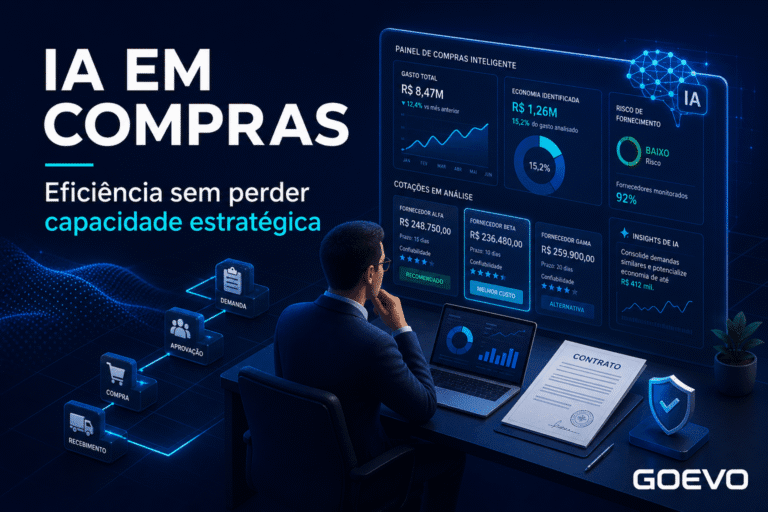
AI can support the classification of demands and expenses, document reading, supplier recommendation, proposal analysis, anomaly detection, negotiation preparation, and requester support. Deloitte It highlights the growing relevance of generative and agent AI, while keeping people involved in the decision-making process.
The value of AI depends on a reliable foundation. When supplier, contract, category, cost center, and order are not connected, the response may appear intelligent but still lack sufficient context.
Therefore, the recommended order is:
- Organize processes, policies, and those responsible;
- Integrate data and preserve traceability;
- Automate repetitive tasks;
- Applying AI to contextual and supervisory decision-making;
- Measuring quality, adoption, risk, and benefit.
In procurement, a quick response without evidence can be worse than a slightly slower, verifiable process.
Frequently asked questions about procurement
What is procurement in simple terms?
It's the structured way a company decides what it needs to acquire, chooses suppliers, negotiates, contracts, purchases, and monitors the results. Purchasing is part of this process, but procurement also includes strategy, risk, contracts, and performance.
How do you translate "procurement" into Portuguese?
The most common translations are purchases, supplies, or acquisition. None of them always preserves the full breadth of the term. Therefore, many companies use "procurement" to represent the strategic function and "purchases" for transactional execution.
Are procurement and purchasing the same thing?
In everyday usage, they can be treated as synonyms. Technically, procurement is broader: it begins with the need, involves sourcing, negotiation, contracts and suppliers, and continues after the transaction. Purchasing focuses on acquisition and order fulfillment.
What is the main objective of procurement?
Generating the best value for the organization by ensuring supply, quality, appropriate total cost, risk management, compliance, and performance. Reducing price can be an objective, but it is not the only one.
What are the procurement steps?
In summary: identify the need, relate budget and category, analyze market and risk, define strategy, qualify suppliers, conduct sourcing and negotiation, formalize contract, request and approve, receive and pay, and evaluate performance.
What is direct and indirect procurement?
Direct costs involve inputs that go into the main product or service. Indirect costs involve goods and services that support the operation, such as technology, maintenance, facilities, and marketing. Both require strategies appropriate to their criticality.
What is the difference between procurement and sourcing?
Sourcing is the search, evaluation, and selection of supply sources. Procurement includes sourcing, but also planning, contracting, execution, supplier management, and monitoring of results.
What is the difference between procurement and supply chain?
Supply chain has a broader scope and coordinates the flow of materials, services, information, and operations. Procurement, on the other hand, acts specifically at the interface between the company and markets and suppliers to acquire external resources.
What is e-procurement?
It is the use of technology to support and automate procurement activities, such as requisitions, sourcing, suppliers, contracts, approvals, orders, receipts, and analysis.
Does Procurement replace ERP?
No. ERP systems can contain procurement capabilities and are often central to tax, accounting, and financial data and records. Specialized platforms can fill gaps and should be integrated into the existing environment.
Is procurement only for large companies?
No. The need depends on volume, risk, categories, units, contracts, and the dispersion of decisions. Medium-sized companies can obtain significant value by organizing processes previously supported by spreadsheets, emails, and isolated controls.
How to start digitization?
Start with the problem and the baseline, not the tool. Map the journey, simplify rules, define data and integrations, choose a pilot scope, and measure adoption, efficiency, compliance, and value.
To move forward with the technology decision, consult How to choose and implement an e-procurement platform in Brazil.
Conclusion: Procurement transforms purchasing into a governed decision.
Procurement broadens the company's vision. Instead of focusing solely on orders, prices, and payments, it begins to connect needs, strategy, suppliers, contracts, budgets, execution, and performance.
This discipline does not eliminate the importance of purchasing nor does it intend to replace ERP. It organizes the relationship between decisions and transactions. When well-structured, it allows for more contextualized purchasing, reduces risks, sustains operations, and enables learning from results.
For GOEVO, evolution happens when the company manages to control its spending. From intention to reality., preserving three principles:
- Governance: Proportionate rules, visibility, and accountability;
- integration: Data flowing between procurement, suppliers, contracts, budget, and ERP;
- Responsible customization: Processes that align with the company's reality without sacrificing standardization and technological sustainability.
If your company already has an ERP system but still relies on spreadsheets, emails, messages, and scattered approvals for purchasing, the challenge is probably not simply recording another transaction. It's connecting and governing the processes that come before and after it.
Next step: get to know how a purchasing system integrated with ERP It can organize requisitions, quotes, approvals, suppliers, contracts, budget, and execution into a traceable journey.
About the author
Wellington Humberto Ferreira da Silva He is the founder of GOEVO and works with technology applied to business management, procurement, and expense governance. This article combines professional and regulatory references with GOEVO's operational experience.
References
Sources consulted and verified in August 24, 2026:
- CIPS — What is procurement?
- CIPS — Procurement and Supply Cycle
- CIPS — Procurement Process
- CIPS — What is eProcurement?
- SAP — Procurement vs. Purchasing: Know the Differences
- SAP — What is source-to-pay?
- SAP — What is procurement-to-pay?
- Oracle — What is ERP?
- ISO — ISO 20400:2017, Sustainable procurement — Guidance
- Deloitte — 2025 Global Chief Procurement Officer Survey
- PwC — Digital Procurement Survey, 5th edition
- GOEVO — Purchasing and Expense Management System integrated with ERP.